Marathon

My Boston Marathon Experience

There’s a joke where you ask, “how do you know if someone is a marathoner?”

The answer: “don’t worry. They’ll tell you.”

This is a reflection of my experiencing running the Boston Marathon. As much as I soaked up the entire day, I feel obligated to write down the experience so it doesn’t fade from memory.

THE BIG PICTURE
In case you hop into this recap with out knowing much about the race, I’ll start with the context. The Boston Marathon is the most prestigious marathon in the world. It’s been run over 125 years and is the loftiest goal for any serious long-distance runner. It’s a one-way course, starting 26.2 miles outside the city in a town called Hopkinton. It meanders through seven different communities before arriving in downtown Boston. Patriot’s Day, the date of the traditional running of the Boston Marathon, takes place the third Monday in April. Local kids are off school for Spring Break and the Red Sox usually have a game that starts in the late morning. It’s an unofficial holiday in the region, meaning tens of thousands of spectators line the course.

Boston is best known most for its qualifying standards. With nearly all marathons, you simply register or win a registration lottery to participate. With Boston, however, unless you connect with a local charity to raise money for them, the only way to get a race bib is to earn it. I’d suggest that this creates the attractiveness of the race. In recent years, as more people have applied, qualifying standards have become even more daunting.

Even though I’m a solid runner now, I had to train extensively to earn a qualifying time back in fall 2019 in Indianapolis. I tell people that qualifying for Boston was the most challenging physical feat I ever performed.

Running Boston is a bucket list for any marathoner and that’s why it meant so much to me.

DAYS BEFORE THE RACE
Unfortunately, Patriot’s Day coincided with Easter weekend this year. As a result, the ladies didn’t accompany me and I went solo. Navigating around the city during the marathon is challenging enough so, while I missed their presence, it was probably best they couldn’t attend. They both thoughtfully made me encouragement notes.

I flew into Boston on Friday afternoon. There’s a free bus into the city from the airport that dropped of just 300 yards from my hotel. The bus was packed with runners and their families but, beyond the shoulder-to-shoulder ride, it was rather convenient. I ended up guiding a family from Indianapolis to our hotel.

My plan for the weekend was to hit up the Expo on Saturday (the day when I would do the majority of walking), and take it easy on Sunday before the Monday race. I still went out for a walk Friday evening (about 4-5 miles) just to keep moving.

I could tell then that my right foot was going to be problematic. The week of the race, I overexerted myself but didn’t think it would matter. I was wrong. By Saturday morning, I could tell that I was hurt. I self-diagnosed a slight case of bursitis in my heel. I’m pretty sure walking almost ten miles on Saturday didn’t help, but the adrenaline of the weekend was starting to kick in.

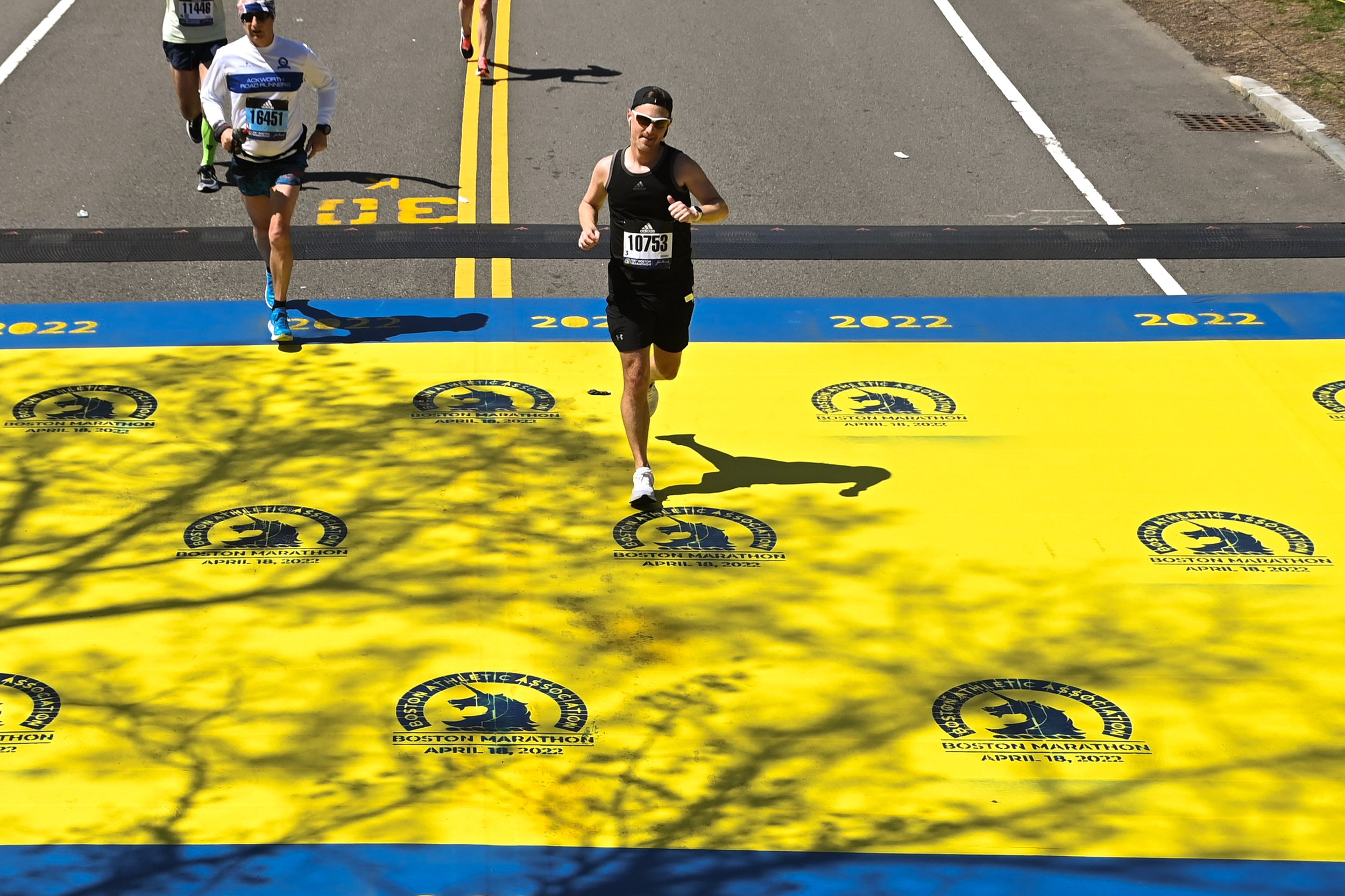
My hotel was closer to the harbor, about 2.5 miles from the finish line. I had to pass by the end of the course on the way to the Expo so I finally got to see Boylston Street set up for the finish. I couldn’t stop grinning. I had a random family take my picture at the finish line. Even though I arrived at the Expo fairly early on Saturday, the crowds were crazy. Picking up my packet was easy while buying licensed gear was chaotic. Hundreds of people were crammed into the tightest of spaces.

Here I’ll offer my biggest complaint about this whole experience: the gear Adidas made for this year’s marathon was lackluster. I desperately wanted a traditional blue/yellow Boston shirt/jacket. Yet this year, they decided to use light purple and florescent green as accent colors; there was nothing with just the iconic Boston colors. I’ll eventually get over this but I think I’ll always be somewhat bitter that these marketing gurus couldn’t get this one thing right.

I still bought a few shirts.

I took the scenic walk back to the hotel but by the time I made it back in the mid-afternoon, my foot was in serious pain. I stopped by a Trader Joe’s, bought some food, and hunkered down for the night. I was planning on going to a local church for Easter services, but shifted to watch our Echo Church services online instead. I spent all Easter Sunday nervous about the next day. Ultimately, I knew nothing was going to keep me from finishing, but I was unsure of what I could accomplish on a bad foot.

RACE MORNING
I slept well Sunday night. I woke up at 5am (normal for me on marathon days) and was out the door at 6:30. It was about a 45 minute walk to get to the location of the bus pick-up in Boston Common. I did research about all this process but the only thing I overlooked was bag drop off. When I’m running the Flying Pig in Cincinnati, I never drop off a bag. But here I knew I’d need supplies post-race so I prepared one. While I assumed the bag drop off would be right with the buses, it was actually a couple of blocks further away. I wasn’t sweating it. My bus slot was 7:30 and my start time was 10:25. I thought I’d be fine. But the buses were late. And then, when we finally started driving, our bus driver got lost on the way out to Hopkinton.

I thought the delay was odd. While we were waiting, a guy next to me told a story about the previous year, when his bus got lost. Then, when another lost bus arrived, some of the people there were telling stories about lost buses in years prior. I found it fascinating that organizers would help the bus drivers with specific directions.

Even though we made it to Hopkinton just15 minutes late, the bus dropped us off on the opposite side of town. I had to walk another 1.5 miles on my bad foot just to get to the check-in center.

They also advertised that their would be food at the check-in center. While there were porto-potties and water/Gatorade, I couldn’t find any food at all. Since I last ate at 6:15, I was nervous that I would be under fueled for the run. That, plus my foot, made me a bit nervous.

They called my group and I walked back into town to my starting corral. At this point, I recognized the area surrounding the starting line. It was so familiar to me after years of watching Boston starts on the television.

I hadn’t run since Wednesday, so I was unsure how my foot would react. But I really didn’t care. I was standing at the most famous starting line in all of running. It was sunny and the weather was in the high 40’s/low 50’s. I had this.

THE PLAN
Since this was my 25th marathon, I had a pretty detailed plan set out.

1. Remember the big picture. I already registered to run the Flying Pig marathon in two weeks; it’ll be my 12th in a row, so I want to keep that streak. I trained well in January and February, but my training waned in recent weeks. An unusually hectic travel season meant I missed a couple of long runs so I wouldn’t have the stamina to run two fast races within two weeks. So I decided to set a realistic goal of a sub-four hour race.

2. Start out slow. This is something that everyone advises about Boston. The course has an overall elevation drop and the first few miles of the race are almost entirely downhill. The temptation is to start fast. Having done so in multiple marathons, and knowing how it can hurt you at the end of a race, I repeatedly reminded myself to watch my pace in the first five kilometers.

3. Take the Newton Hills. At mile 16, there are a series of four hills, culminating in the historic Heartbreak Hill. Since I run in Cincinnati, I’m practically a maestro of running hills. More than anything, I vowed to take every hill without walking.

4. Soak it in. While I might make it back to this starting line some day, this could be the only time I run Boston. Just in case, I would focus more on the experience than my finishing time.

THE RACE (BEGINNING)
I had a solid qualifying time for my age, so I was near the front of the second wave out. At the gun, I just started running. I mentioned that it was downhill from the start, so I struggled to gauge how my foot was holding up. I was able to run on it without pain, only slight discomfort.

My biggest concern was the pace. My running watch can sometimes be off, but I kept looking down to see that the pace was far too fast for me. Additionally, it’s an incredibly tight course at the beginning. I was hit multiple times by people trying to fly past me. I essentially had to tuck my arms in for the first couple of miles to avoid getting hit. I would nestle in behind someone going slower but, when they saw the crowd around them, they’d speed up. I knew I had to find my own pace.

I pushed over to the far right side of the road, where the asphalt would turn to gravel and dirt. Out of Hopkinton, it’s a bit more rural so there were few spectators on the edge. Despite this far right position, there were still people flying past me on the outside. It stayed like this for almost the first ten miles of the race. Even though it was slightly distressing, seeing so many people fly past me, I was still confident in my strategy.

I mentioned my lack of food but, fortunately, there were random spectators handing out things like oranges slices and licorice sticks. For the first part of the race, I ate anything anyone handed me. Days later, I haven’t felt food poisoning, so chalk about another victory for me.

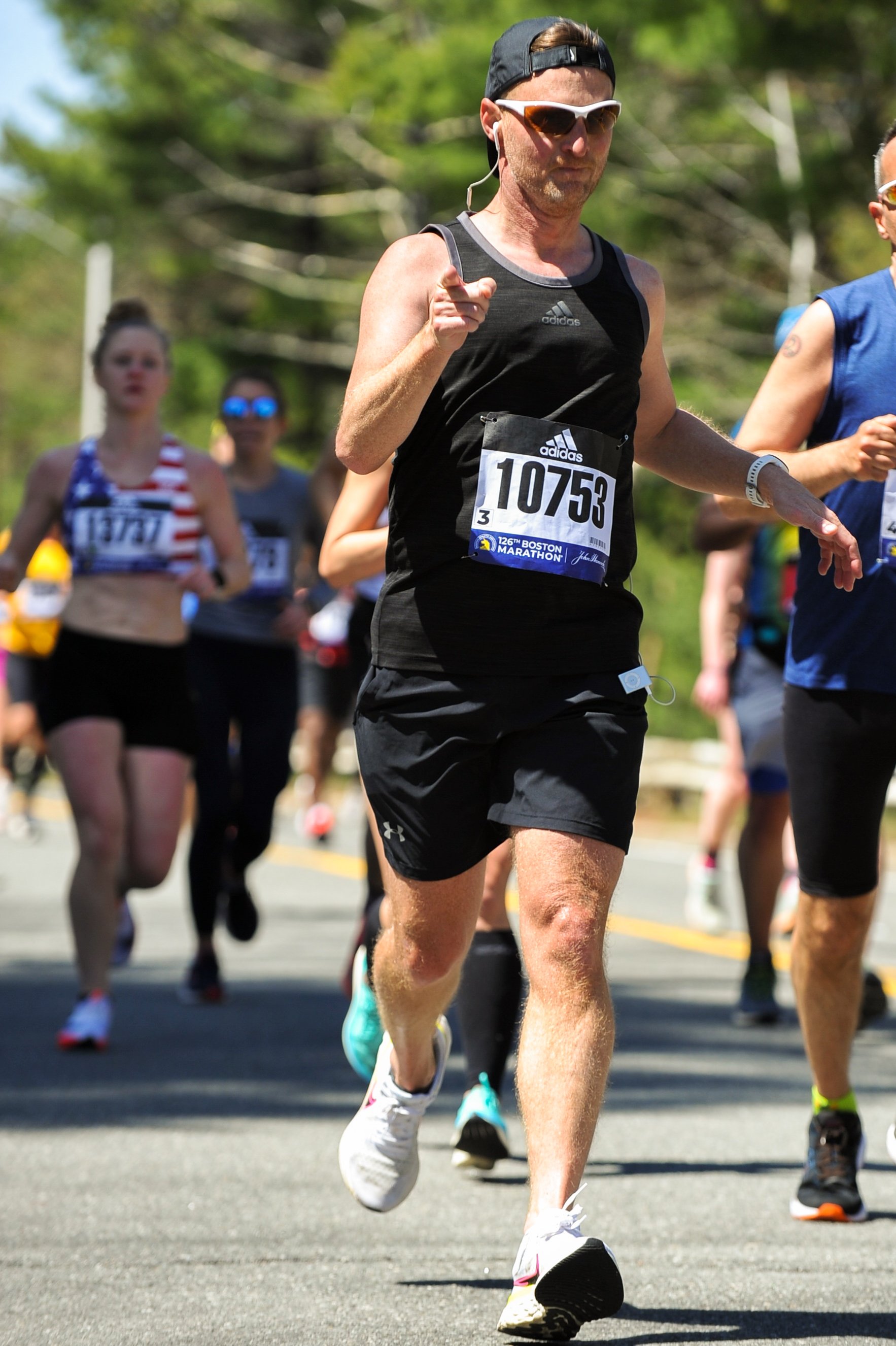
After those earliest miles, as I kept my turtle pace, I found myself close to the spectators. So many kids had their hands extended for high-fives but my group was pushing hard and didn’t seem interested in engaging with the crowd. Since I was slower, and occupied the edge, I started giving high-fives to everyone with an outstretched hand. Without a doubt, I have never hit hands with more people in my life. It’s tough to give a high-five during a race, especially to kids; you don’t want to hurt them, so you just let your hand glide by behind you. I cherished there enthusiasm. And in the middle of all this, I got to see Spencer, the official dog of the marathon.

I don’t remember much more about the start of the race. I was trying to stay calm, encourage the crowds as they were encouraging me, and maintain a steady pace. Even through mile ten I thought I was going too fast. Eventually, I remembered that my foot had been hurt, but it was holding up well. I knew that I could finish the race, even if my goal of sub-four hour run wouldn’t materialize.

THE RACE (MIDDLE)
Approaching the halfway, I felt confident. I could tell I trained sufficiently enough. Before the race, I had memorized the order of the towns on the way in (Ashland, Framingham, Natick) so I’d check them off my mental list every time I hit the town limits. I was still giving high-fives as I entered into Wellesley and started to hear a roar.

Wellesley College is an all-girls school and they’re known for their scream tunnel, as the students line up to yell at the top of their lungs. It’s also known as a spot where runners occasionally stop for a kiss from a student; many even had signs requesting a kiss. Being happily married (and also questioning the tradition in an era of #MeToo), I felt the high-fives were a sufficient exchange.

Up ahead was the town of Newton, the aforementioned location of the hills. Knowing the challenge that loomed ahead at mile 16, I spent miles 14-16 trying to slow down my pace. Here the course starts to descend before the hills, so slowing down was more challenging than I anticipated. As runners started flying past me, I prepared myself for the enjoyable hill run in my running career.

The first hill is a long one. I attacked it with vigor, perhaps even speeding up from my standard pace. As I neared the top of the hill, I started passing a couple of walkers. I nailed it.

The second hill was forgettable. Apparently it was steeper than the first, but I’m not sure I could tell. I pushed through this too, and the amount of walkers increased. After cresting, I first felt fatigued. I mentally prepared myself that the third hill would be the most challenging. I was only halfway through the hills, and I needed enough in the tank to still take Heartbreak.

Predictably, my pace slowed for the third hill. I never stopped running, but gravity started pulling at me. This was the hill where the walking of my fellow marathoners was most noticeable. Since everyone knew Heartbreak was ahead, those who were exhausted took the opportunity to walk. I felt like a snail but I still passed people.

Finally, I found myself at the foot of Heartbreak Hill. It might have been the easiest of the four, if not for its length (half a mile), its location on the course (twenty miles in), and the fact that there were three hills right before it. Knowing this is the hill run of my life, I pushed with everything I had Very few people were walking here, buoyed by the crowds who fully understood the meaning of this moment. It was so loud. They begged runners not to give up.

There’s a banner hovering over the street at the top of the hill. That became my sole focus. Eyes fixed, head up (the key to hill running), I pressed toward the top. I was actually passed a couple of times here by other runners feeding off adrenaline.

At the top, I briefly lifted my hands in triumph, knowing that one of my goals was achieved. I took the hills.

THE RACE (END)
After the peak at Heartbreak, I used the slight downhill period to rest. But at the hill’s crest, I immediately felt a fierce wind in my face. There was a strong headwind coming from the city that made a pleasant fifty degree day feel cool; the wind was a wall slowing me down. I didn’t care much for this win and, when combined with the exhaustion, I knew these last five miles would be an absolute grind. I had little left in the tank. Missing out on some long training runs in March cost me here.

To cope, I used the following water stops to take a breather. Early in the race, I was drinking only Gatorade to try to build up carbs. At the end, I was thirsty and drank 2-3 cups of water every stop. At the end of each water line, I’d walk while drinking two cups. When I was finished, I’d start running again.

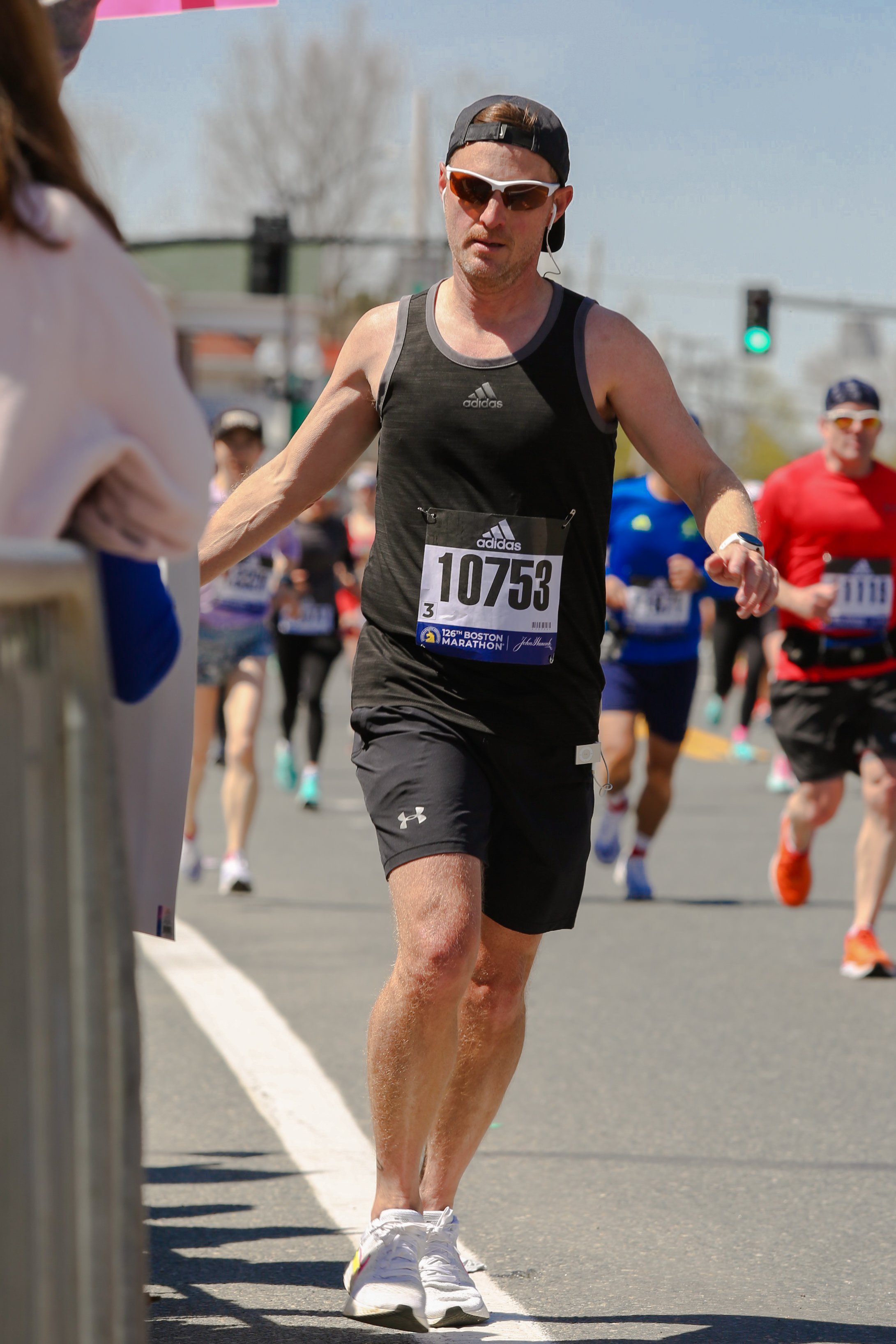
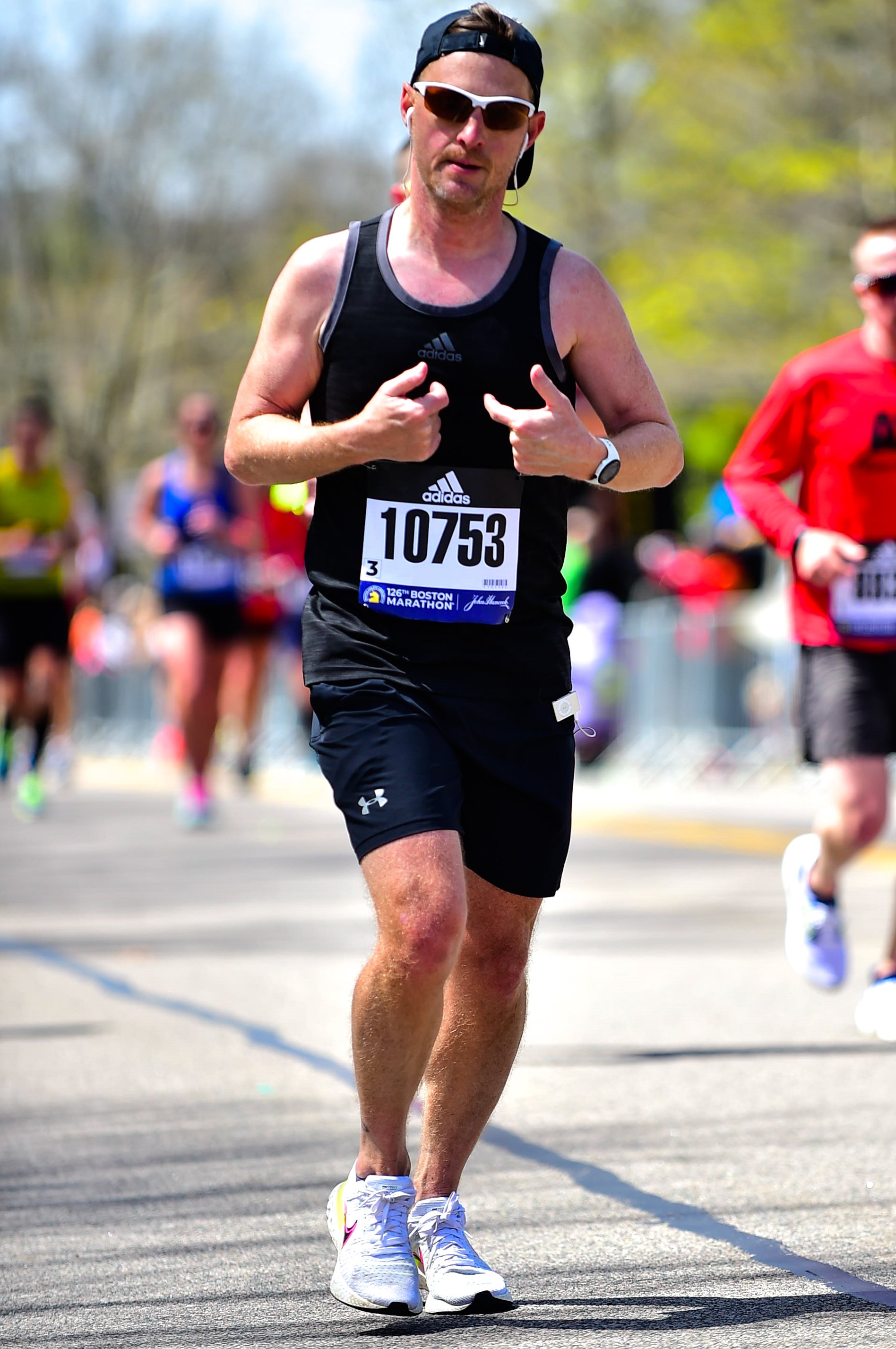
Moving from Brookline into Boston, the crowds began to grow. People started seeing my name on my race bib and encouraging me by name. While I spent the first part of the race trying to inspire spectators with high-fives, I spent the final part of the race feeding off their energy. I never had such an experience in my previous marathons. I took out my headphones so I could fully hear the crowds.

I was planning on skipping the water stop at mile 23 but I was so thirsty. I knew I needed one more stop. As I took my waters and walked it out, there were four college guys who implored me to run.

They yelled, ”you got this! You don’t need to walk!”

I responded, “last water stop, boys. I’m onto the finish line.”

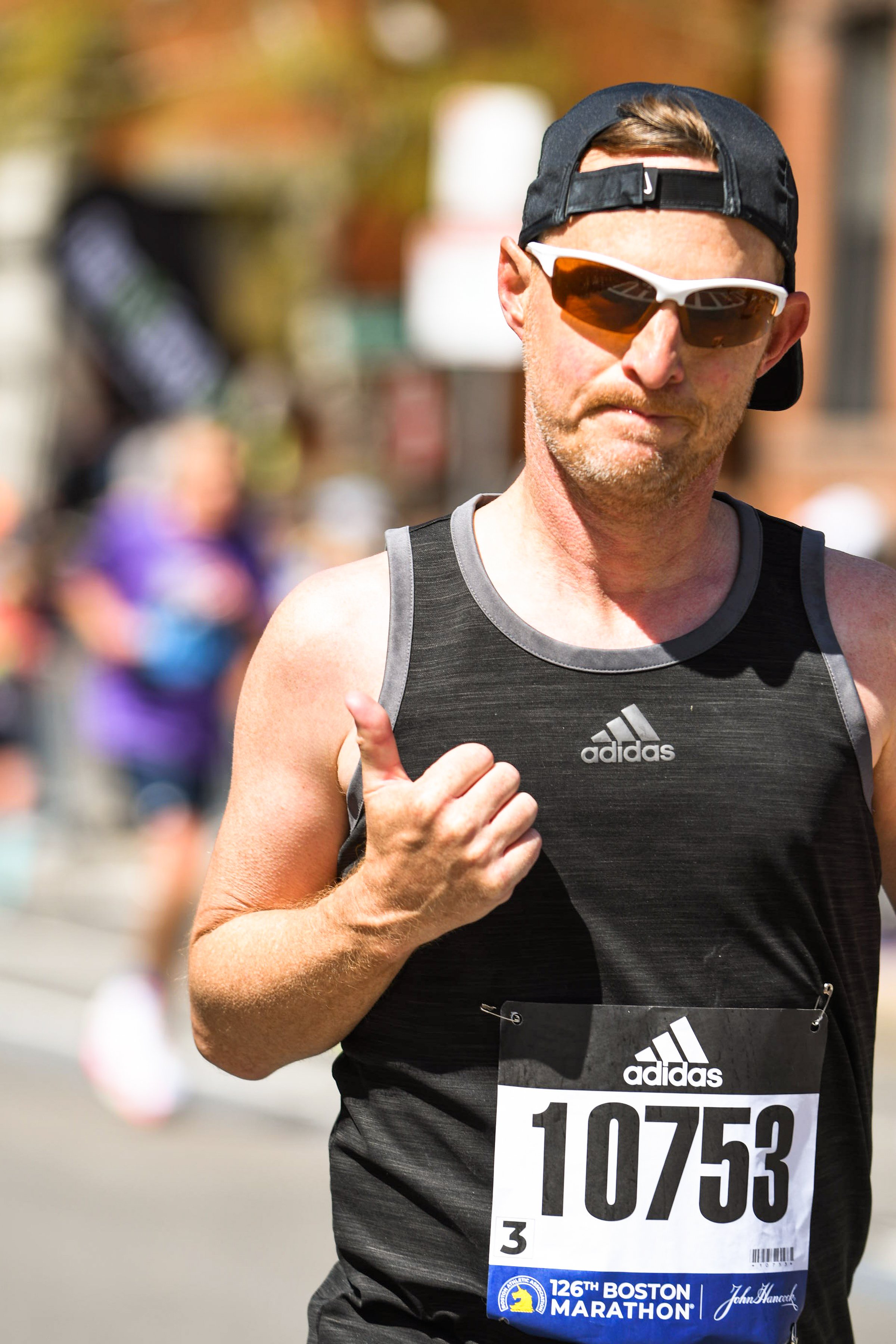
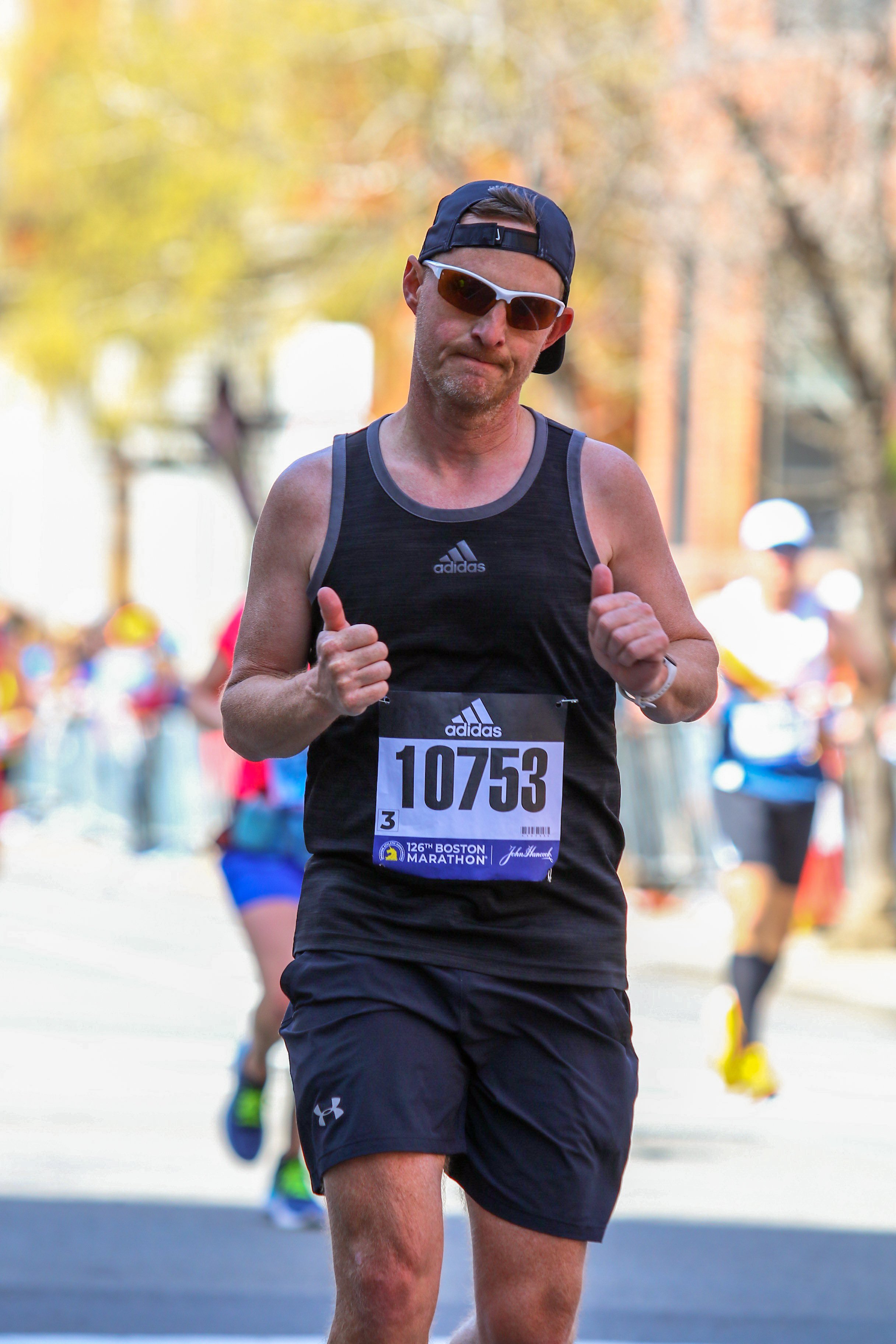
I gulped my water, tossed the cups, and started running again. The four of them yelled “STEVE” as I ran off. I gave them a thumbs up in the air.

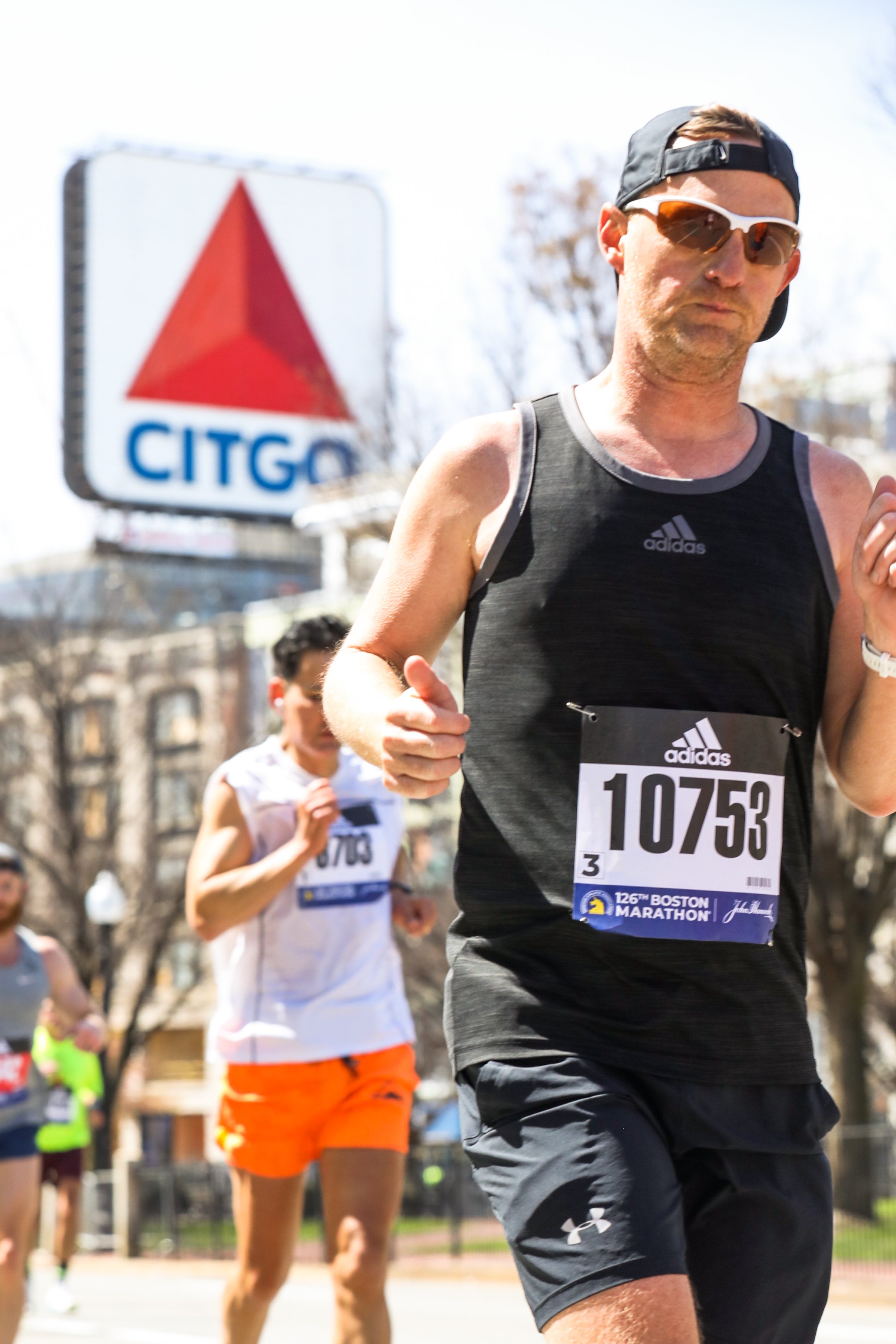
The iconic Citgo gas sign was finally in my sights. I knew Fenway Park was right next to it, so I finally felt close. On previous visits to Boston before, I’ve been in this Kenmore Square area so I started recognizing streets and landmarks.

One Commonwealth Avenue, I saw the “one mile to go” sign. Looking at my watch, I knew I’d hit a sub-four hour race (actually sub-3:50) so I actually slowed down. This is counterintuitive for marathon runners, and I started getting passed a lot. But I couldn’t care less. This was the finish I dreamed about for years and I was content to live in the moment instead of worrying about the clock. I knew I executed my race plan.

I couldn’t stop smiling.

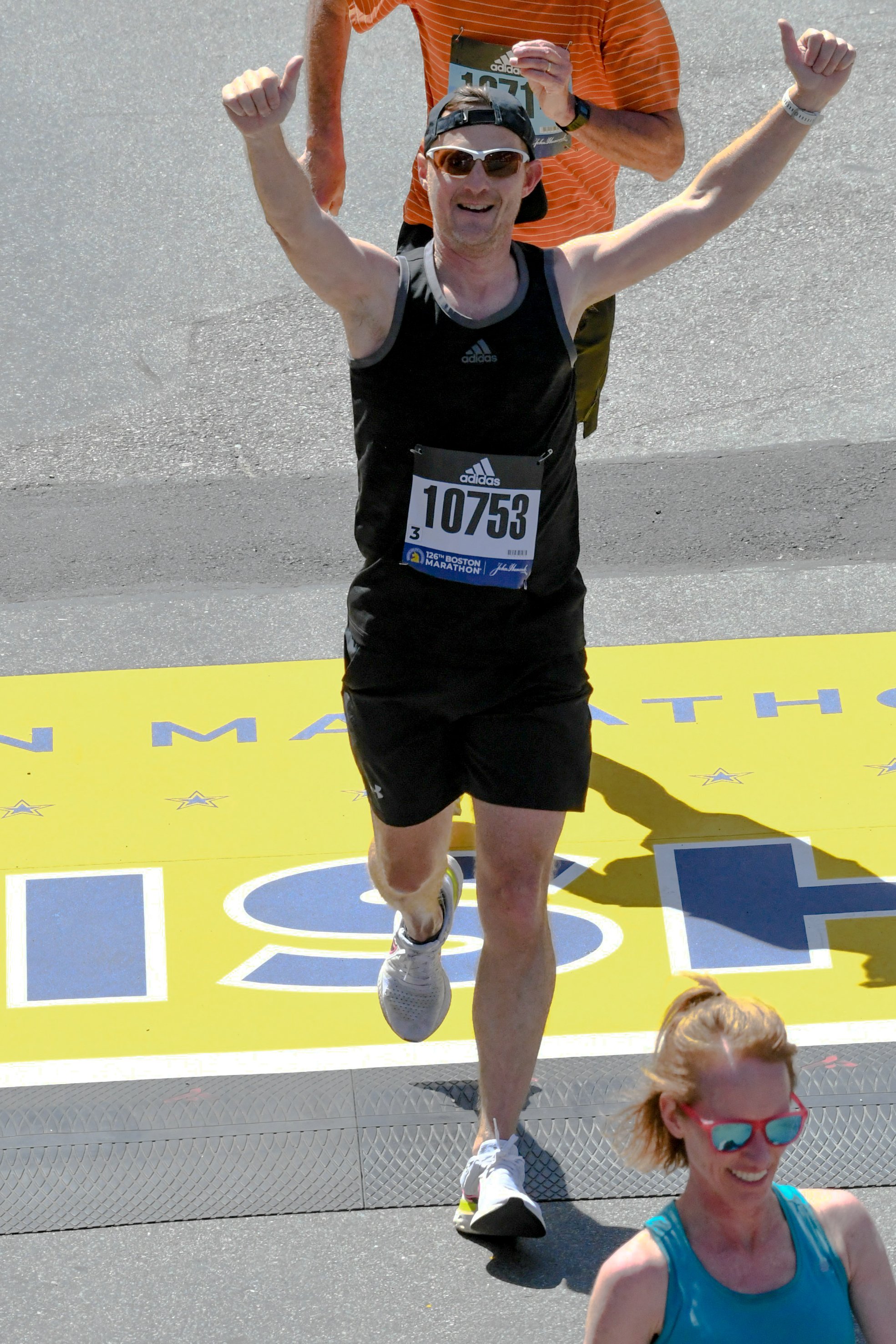
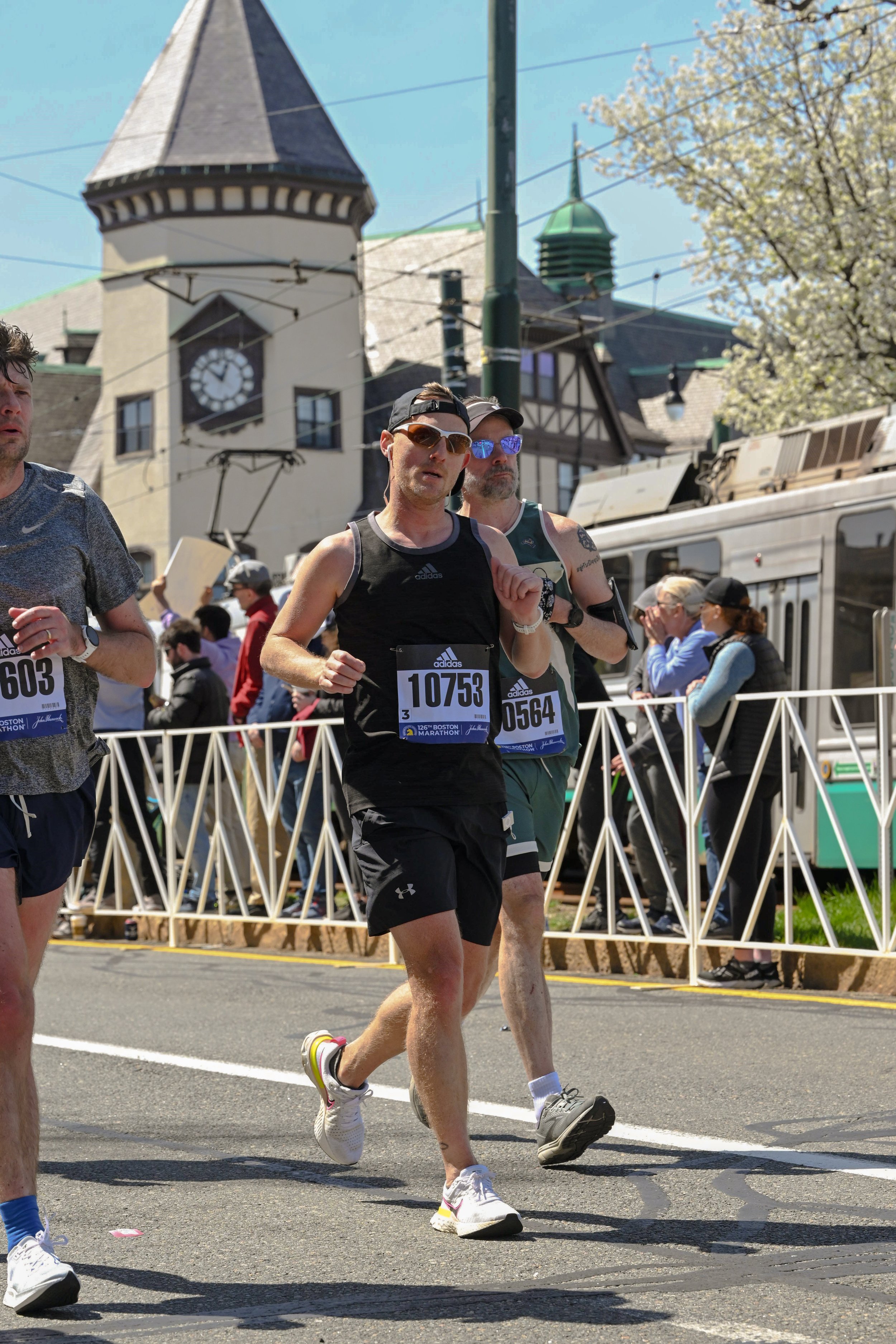
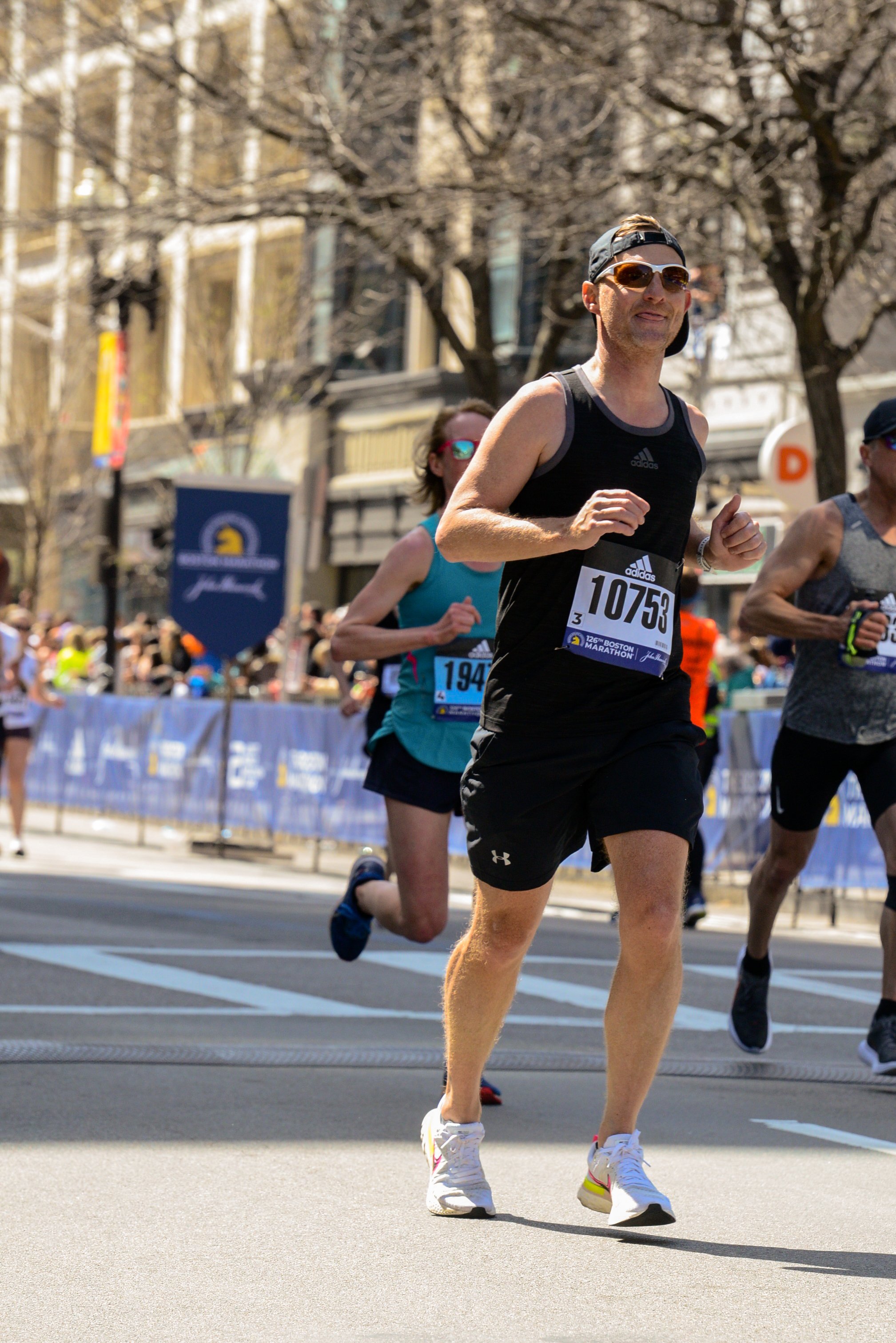
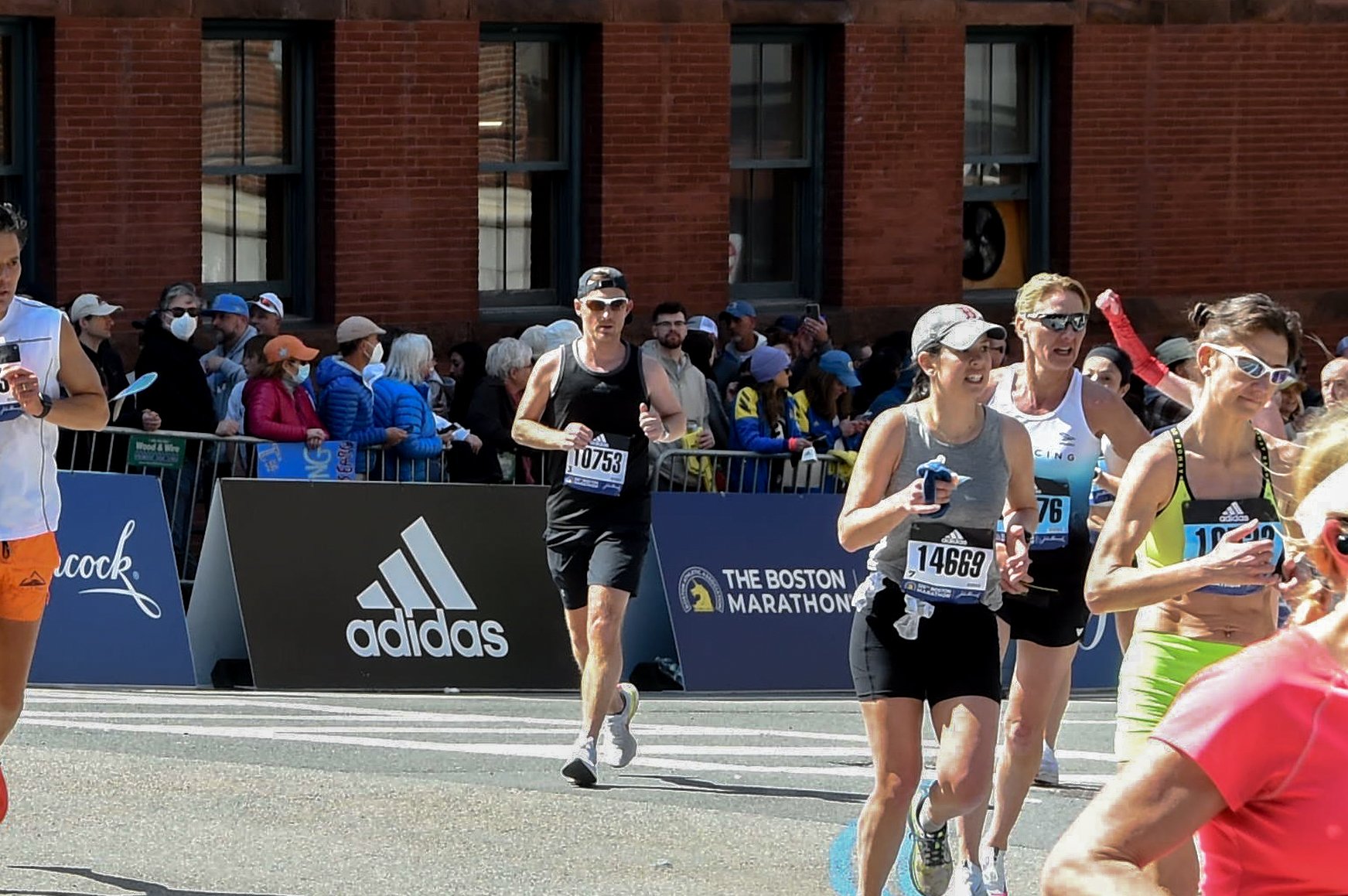
I made the two most iconic turns in marathon lore: right on Hereford, left on Boylston. I could finally see the finish line and felt the energy from the crowd assembled along the course. I was exhausted so my focus on pushing through almost kept me from absorbing the moment. A few tenths of a mile out, I through up my arms and kept my thumbs up. The crowd was boisterous and they carried me home.

My finish was 3 hours, 48 minutes, 17 seconds.

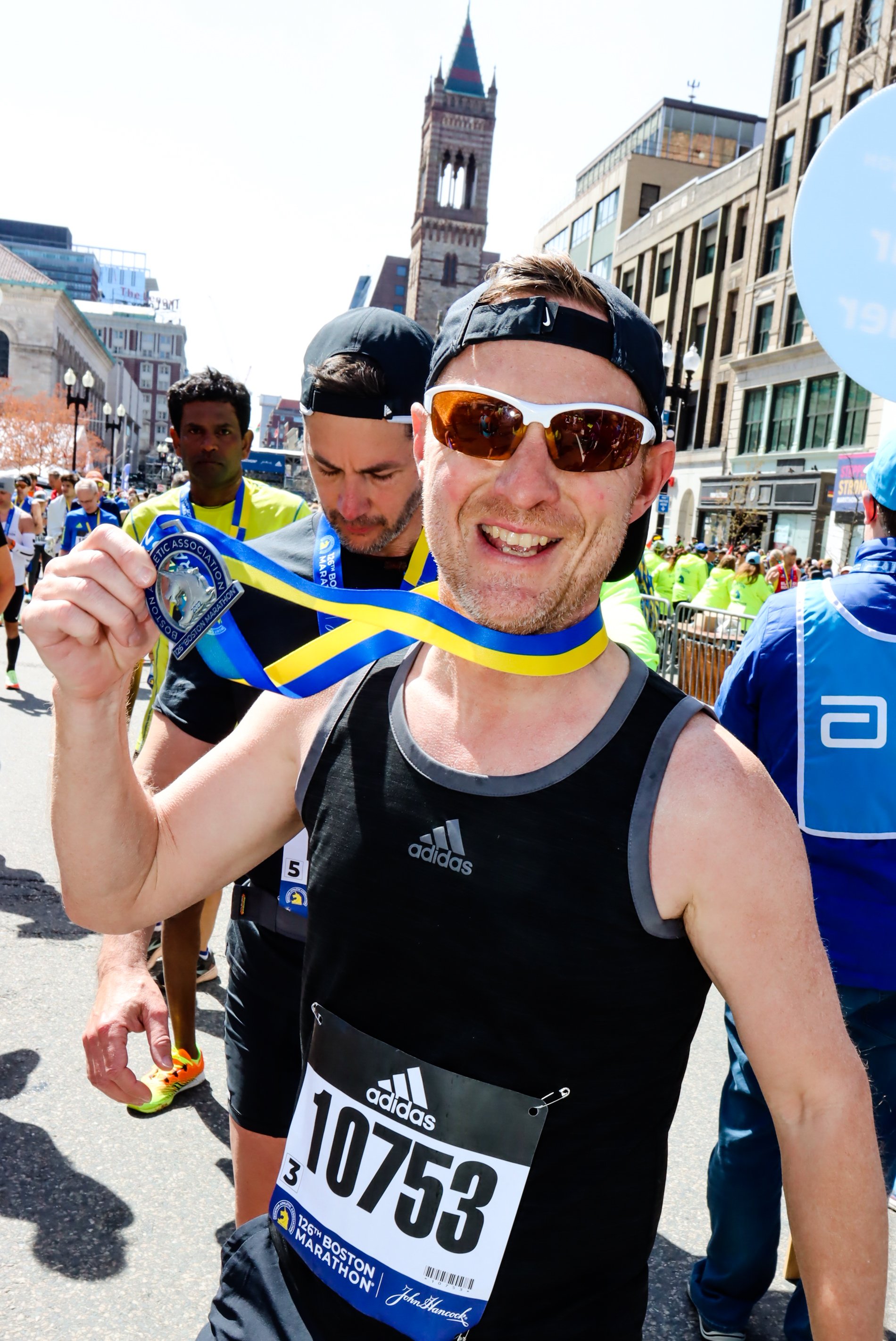
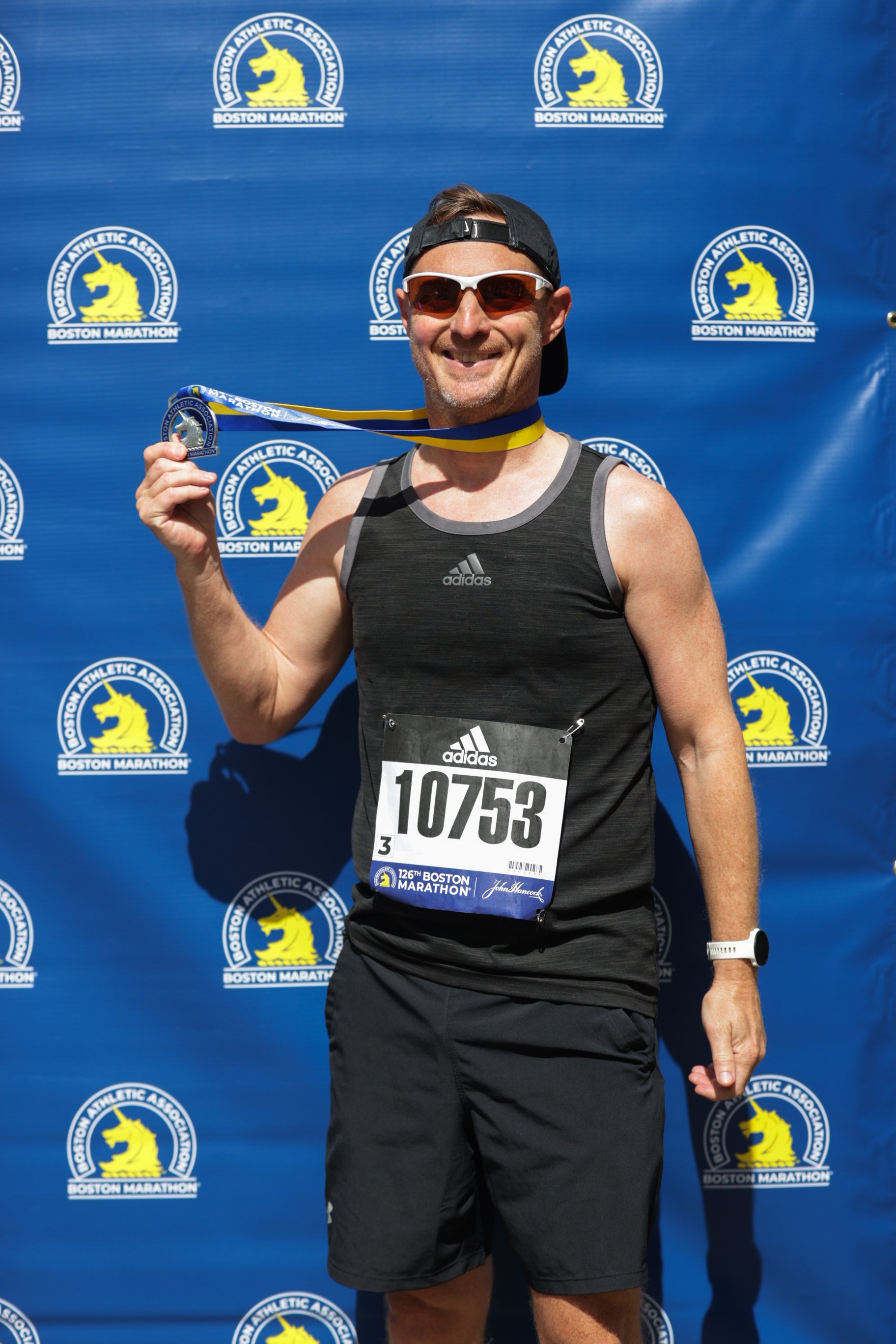
I finished in the bottom 30% of male participants and in the bottom 25% of my age group. Percentage wise, that’s probably the worst I’ve ever performed, even though it was my 11th fastest marathon. But I laugh at those stats. I really can’t be bothered. I have a Boston finisher medal.

IN THE END
It was obviously an unforgettable day. Every marathon is challenging, but the suffering was most enjoyable.

At the moment, I don’t see myself trying to qualify again any time soon. I proved to myself that I could do it and, frankly, I don’t feel motivated to try. I’ll keep running the Flying Pig every year, and might try a few more when the kid graduates high school, but I’ll hold off until I age into a new qualifying bracket. If I can stay in shape, I won’t have to attain such a low qualifying time.

Now, I look forward to new challenges designed to keep me from complacency. Don’t worry; I’ll tell you.
Day One Ish

It's time to get back on the horse and aim my sights a second time on Boston qualifying. I rested the last three weeks after the Flying Pig marathon, ate virtually anything I wanted, and healed up from the leg injury that kept me from qualifying. I woke up this morning and headed out on my first training run.

It just wasn't easy. As I started out, I felt I was at a crawling pace. I had to constantly remind myself that it's difficult to pick up training again and that I'd feel differently by the end of the summer. Yet even though I felt like slow motion, my pace this morning was faster than anything I did in my first three weeks of training this year; and that was in the humidity of the summer. 

Not sure if I'll document this charge as much as my previous one, but I'm focused and ready to roll.

Failure

I was not successful in qualifying for the Boston Marathon. 

I had no idea whether I was even healthy enough to give it a go. Treating my soleus injury led me to rest, stretch, ice, and rub multiple lotions on my right leg. Even though it didn’t feel normal in the days before the race, I wasn’t going to conclude my strongest training season without at least trying to run. Additionally, the conditions for 2017's Flying Pig Marathon were likely the best there will ever be, so I sold myself that it was meant to be.

At the starting line, I worked my way to the front of my corral, beginning just seconds behind the leaders. I felt fine and quickly found my pace group. I’ve never stuck with a pace group for entire race but I decided this would be the best strategy to keep on track. A couple of miles in and the pace felt comfortable. My leg was tight, but not really painful. I was even handling the early hills with ease.

Then right at mile three I felt a stabbing pain. I quickly realized I wasn’t BQ’ing in this race.

Since I was still near the front of a 20,000 person pack, I pulled off onto the sidewalk and slowed down to a crawl. I didn’t walk, but there was shooting pain in nearly every step; I couldn’t imagine another 23 miles of this. I figured I could limp my way another five miles to my house and call it a day. 

After leaving downtown, I started up the infamous Gilbert Hill. At this point, the pain was less stabbing and more a consistent discomfort. “Maybe you can do the half marathon,” I told myself. "At least then you’d have something to show for it.” As I worked through my inner dialogue, something happened. I’m not sure what it was—if it was the hill stretching out my leg or my pure stubbornness—but at the top of Eden Park, I felt like I could finish this race. Even though the leg was still painful, and I couldn’t run at optimal speed, I knew I could finish. My brother-in-law was at our house with Kaelyn and my niece (my sister and her twins ran the half). I told them that I was hobbled but to look for me to finish around 4:30. Just up the street, as the half and the full routes split, I turned right to run my 26.2. 

I continued to tolerate the pain and even picked up speed over the next few miles. Again, I wasn’t running well, evidenced by the unusual blisters on my feet; I was striking the ground differently to compensate for the injury and my feet paid a toll. But I was still running it out. Just surviving helped me deal with the BQ depression. My adjusted goal was to finish well. And without noticing, I was making decent time.

Side note: There are always marathon moments that people don’t discuss—incidents that are not at all glamorous and quite disgusting. About sixteen miles in, my innards rebelled against me. I found a porto-potty and thought I was good until five minutes later. Not sure if it was a reaction to my pain or not. Regardless, despite bathing in hand wash, I always feel guilty when the kids want a high five. 

After mile twenty, my coping left me with tired legs, but I still had my fitness. I never walked during the race, partly because it’s my but mantra but mostly because it wouldn’t have solved the pain in my leg. And I know the course so well that I was able to maintain a solid mental state. I wasn’t even looking at my time. At mile 25, I finally realized that I would finish just under four hours. It was a nice little bonus, knowing that the pain was worth it. Without my intense training, I doubt I could’ve finished under five hours. 

At the finish line I just stopped without emotion. I took my medal. I found my family. 

It’s a day later and I’m in terrible shape. Thankfully I didn’t have to leave the house today (working at home has it’s privileges) because I’m not sure I could have walked more than ten yards at a time; I haven’t felt this bad after a marathon in years. I won’t be able to even think about running for a few weeks and recovery could take up to a month. 

You see, I didn’t know how I’d react to not qualifying. Because I was able to persevere yesterday, I’m OK with it because I know it still hasn’t gotten my best shot. At the very least, the past few months of training helped my discover what it will take for me to get there. And there are countless ways where I can improve: I can better monitor my fitness, work on my diet, and maybe even integrate some stretching to prevent injury. Even though I didn’t fail because of lack of preparation, I’m not going to become complacent.

Failure provides opportunities for reflection. And even though I’m tough on myself, I don’t regret anything I did. I could chalk this defeat up to the fact that I’m not athletic enough to BQ, but I just can’t admit that. I’m not going to give up. I’m going to try again.

This morning I signed up for my next marathon. 

Gutted

I’m always processing. While I mostly tend to do this verbally, I’ve discovered writing is another medium to do so. Since I’ve catalogued many aspects of my BQ journey here on this site, I might as well open up about my race week neuroses as well.

My leg injury has not improved at all. I rested and iced it well over the weekend. Monday afternoon, I volunteered to chaperone Kaelyn’s running club at school, figuring it would be a good opportunity to test it out. I started well, but just half a mile in, I felt emerging tightness and discomfort. Even though the pain increased, I continued on since I was supervising the children. It’s no fluke: this injury just isn't going away quickly.

At first, I was thinking it was an achilles, as I’ve had issues with it before in this leg. But yesterday I pinpointed it a little higher on the leg—the soleus muscle—which ties the achilles to the calf muscles. Of course, there’ s no easy fix for it. Time is usually the best medicine, but I have a mere five days to go until the marathon.

It’s demoralizing because I haven’t had a significant running injury in a few years. I’ve learned not to increase my mileage too dramatically and adopted a consistent posture and that’s kept me relatively free from injury. And my fitness is as high as it’s ever been; if I had run the marathon just three weeks ago, I probably could have BQ’d with time to spare. Now, I’m trying to keep from being depressed while contemplating race strategies. 

I’m not convinced that, even if I take a few Advil and use some heat ointment, that I could perform optimally at 26.2 miles on a less-than-optimal leg; I won’t really know until I start the race, and would have to readjust my goal on the course. If I can’t reach the BQ time, I’d still like to finish; I’ve never DNF’d a race so that’s looming in the back of my mind. But whereas years ago my goal was merely to finish marathons, it’s now all about peak performance. I could still take a shot at a BQ this fall in Indianapolis but, if I further injure myself on Sunday trying to finish the race, this goal could evaporate for another year.

I’m not right in the head, hence writing an entire post about it.

As I think about this injury, I get both extremely sad and angry. I continually start to utter the phrase, “this isn’t fair . . .” but I cut myself off in mid-sentence. One of the blessings of a career teaching people how to function in a universe that God created is that I know that “fair” is a deceptive concept; seeing wonderful people die far too early reminds me that this fallen world lacks the eternal perfection we’re longing to experience. This knowledge is countered by one of the curses of being a theologian: when you actually have to live out what you teach. 

While preaching this past Sunday, I highlighted a often forgotten phrase written by the apostle Paul in Philippians 1:18: “But what does it matter?” In the scheme of things, we take things in life that lack an eternal resonance far too seriously. This isn’t to say we can’t be frustrated at the little inconveniences of life. I mean, getting a leg injury just days before a race absolutely sucks. But then again, I also shouldn’t get too worked up about it. Some things are just outside of my control. There’s not anything I can imagine I could have done differently here (it’s why I’m an emotional head case right now). So I just need to keep a good perspective with this.

It’s yet another opportunity to see if I can actually live out the faith that I tell people I have.

Again, I didn't need to post this, but I felt compelled to do so. On Sunday afternoon, when the marathon is over, maybe these words will help me. Or maybe in a year from now, this post will remind me how my feelings in this moment were unnecessary. I have no idea. 

I’ll be patient. I’ll keep the faith. And I’ll trust it will all work out.

Last Push

For the sake of documentation, I needed one more post about the lead-up to my quest to Boston qualify. 

In the spring I learned that the wife and some friends were looking to run the Flying Pig marathon relay (splitting up the 26.2 between four runners). Since I love this race, I signed up to pace them. Sure, turning around two marathons in eight days would be a challenge, but at a slower pace I was sure I could do it. In the back of my head, I also knew I'd have a back-up race in case something happened at Louisville. 

So something happened at Louisville.

I had been monitoring the weather from two weeks out. Those forecasts are highly inconsistent, but at least it paints a good picture of what to expect. From that first forecast to the days before, everything pointed to marathon temperatures above 80 degrees. This isn't good at all for marathon runners. I ran a race in that kind of heat, and despite your best efforts, it's impossible to keep your body cool enough to get maximum results (it was the only race I ever had to walk through, and I'm still proud of finishing it). If those race day temps would hold, there was no way I could BQ. 

A few days before, with the radar also calling for thunderstorms, I had a choice to make. The forecast for the Flying Pig looked much better, with a high in the mid-sixties, so my meteorological data was compelling. Still, the reason so few attempt to BQ in Cincinnati is because of the challenging topography. I had to pick my poison: heat or hills.

I made the strategic decision to not run the Derby Festival Marathon. I'll try to conquer the Flying Pig Marathon and its hills this Sunday.

My decision was affirmed when I tracked the race day weather in Louisville: they had to delay the start of the race 90 minutes because of thunderstorms. Additionally, about half-an-hour after the start, it rained hard and soaked the runners. The heat wasn't quite as high as earlier predicted because of the cloud cover, but it still would've been highly difficult to nail my goal.

And it all might have been serendipitous as I picked up a minor injury. About nine days ago, I did some yard work involving some heavy shoveling. The repeated action of pressing into the soil with the shovel strained my calf (the same leg where I've suffered from achilles problems). My most recent run was so awkward that I stopped altogether. Obviously, this impacts the mind more than anything. I can chalk up my rest to a good taper, but I'm icing and treating this thing as best as possible. I'm feeling good that, with a few Advil and some heat rub, I can make it through just fine.

If there are lessons here, it's gotta be that you just have to be prepared for anything in this process. I have to trust that I did my training and that will carry me through. My attitude is fairly strong, even though the goal has become even more challenging. I think the home field advantage will serve me well. I'm not afraid of hills (it's a necessity of training where I live) but I'm hoping I have enough left in the tank for a strong finish.

Mind Games

I'm a mere ten days away from my Boston Qualifying attempt. There's been some peaks and valleys along the way (both literally and metaphorically), but I'm incredibly pleased with the training I've put in. Even though I had some doubts early on, I've slimmed down to my lowest weight since high school and my times have continued to decrease (despite my earlier concerns). I've put in more 18+ mile runs than any point in my training and have logged far more miles than I ever had in preparation for a race. I was even able to match part of the Boston Marathon on Monday to help cement a visual of what I'm working toward. 

But it's still doesn't mean that I'm without fear. I'm still afraid to fail.

This is somewhat silly because virtually everything I've accomplished in life has been the result of taking risk in the shadow of failure. Yet I'm coming to believe that this risk actually carries more weight than nearly all the others I've ever attempted.

That's a bold statement but hear me out: it's not that I believe that attempting to BQ is the most monumental task I've ever tried to accomplish. It's just that few have ever had such a defined measure of success or failure. Even more, fewer have rested on a particular moment as this one does

A couple of examples of previous risks I've taken to put this in context: first, undertaking my doctoral program. I invested a lot of time and money in that process. And I put forth an immense amount of effort to get the work done. But even if I hadn't met my original deadlines, I could have merely paid an extension and taken another stab at it the following semester. And I knew that, if I put in the effort, I had the aptitude to complete the program. 

A second example: starting Echo. We risked much when my pregnant wife and I moved to the city, me forgoing a consistent paycheck, to start our fellowship. I didn't see it that way at the time (maybe my arrogance hid the fears), but it wasn't quite as risky as I imagined. Even though I visualized this jump as one without a parachute, asserting our unwavering commitment to the cause, I knew I could always find work in some industry if it fell through. As long as I had a realistic view of success (the church still exists almost twelve years later), I knew we could win on this risk.

In contrast, attempting to Boston Qualify is a once (or at the most twice) a year deal. And it could be much less if some sort of injury comes my way. I've committed four solid months (in addition to the past nine years of running) to this goal. If I don't meet it this Saturday, then I'm back at square one. I'd have to put in the time again, still with no guarantee of success.

That's the source of my fear . . . or perhaps more accurately, my anxiousness. 

I'll still run in the following days, but my body is as prepped as can be; in fact, gains in running usually take six weeks to kick in, so any work I do now will have little affect on my performance (research tapering before a marathon, and you'll get a better idea of what I'm talking about). Over the next week and a half, it's about me getting right between my ears. I need to be confident that I've done the work and mentally prepared to give it all during the race. 

And, as I've occasionally considered throughout this time, I might need to grapple with failure to reach my ultimate goal. If that's the result, I'm sure I'll have gleaned numerous lessons throughout the process, but I'm still grateful that I'm taking the risk. And I'm thankful to have the space to articulate these fears so I can remember them after the fact. 

Until then, it's all about positive thinking.
 

Streakin'

A little bit of an update about my marathon training. Again, this is really just an opportunity for me to capture what I'm feeling through this process, so I apologize if it comes across as I'm too self-involved.

My training went really well in January and February. I'm charting my runs and there's a definitive trend of my gaining speed. The mild winter permitted me to get outside much more than I normally would. Even though I'm a workhorse on a treadmill, there is that point in March when you're about done with it so banking those early days outside helps your mentality.

My work travel schedule has been intense the past seven weeks or so, so maintaining my training schedule required deliberate planning: if I fly out in the morning, I need to allow treadmill time that night, or if I fly out late, I need to run early at home. Still, what was once laborious has now become a habit. I've never trained this hard for a race. Through this week, I had run every day, compiling a 72-day streak. 

On day 72, however, I started feeling ill. I just returned from a road trip and I picked up a cold. I'm trying to assume some of the blame as I neglected to take my regular dosage of Vitamin C. More likely, I'd say it was the combination of an intense schedule, being in confined spaces in the winter months, and disrupted sleep that made me susceptible to getting sick.

Then on Tuesday I faced a conundrum: do I press through while sick, keep the streak alive and put some mileage in on the treadmill or rest? As much as I wasn't feeling well, I was fighting visions of running every day in 2017 and basking in its glow on December 31st. I loved the idea of a year long streak. I even mentioned it multiple times to Kelly that day, as if maybe she would tell me to stop being a wimp and go for a run. She intelligently chose to listen and empathize instead.

The streak came to an end on Tuesday. In fact, I felt so bad that I didn't run the past three days. 

I was reading blogs and web-forums about people who run everyday and I stopped doing so on Tuesday; I don't feel worthy anymore. Even though I'm doing well and have developed this habit, I'm wrestling with feelings of failure. But I still chose not to run.

I think what made me comfortable with abandoning the streak was that it wasn't my true goal. As much as I enjoyed the feeling of running every day, I'm still laser focused on a specific finish time on April 29th. I always tell new marathoners that taking a few days off isn't a bad thing (it's why the most difficult thing dedicated runners do is taper). It was key that I keep the big picture in mind while pressing through those feels to swap out a goal at the last minute.

If you've read this far, you're either a runner looking for info (I see ya) or someone just peering into my soul. I don't want to have brought you this far without a lesson, so it's gotta be to steer clear from distractions, even when they're justified. Sure, I could have pressed through instead of resting, but I very easily could have prolonged that illness. I feel like I'm getting over it. The mind is a powerful thing and it will sometimes turn on you if you don't stay focused. That's really why I wanted to write this: to remind my own brain who's in charge.

I ran seven miles on the treadmill this morning. Felt good. New streak started.

Where Resolutions Go To Die

Just three weeks into my quest to Boston Qualify, and I've hit that first seed of doubt. It's funny: I knew this was coming, but my mind was still susceptible to it.

You see, doing something for three weeks (or four weeks, depending on whom you ask) establishes a habit. In this goal, I've already witnessed that my mind is becoming wired to put in the running time; the other night, when a freezing rainstorm was rolling in, I put on my shoes and claimed my miles. A few years ago, even while marathon training, I would have stayed on the couch.

The issue, however, is the need for positive feedback. Although I'm "feeling" stronger, my running times aren't reflecting the work I've already put in. Again, I can deal with this cognitively: I took the month of December off, so I know I'm still getting back in shape. While I shouldn't be seeing the results yet, I secretly long for that affirmation to keep me going. 

And this is why people give up so early: they don't fully trust the strategy.

I'm obviously going to keep on running the plan and try not let it get in my head. But the lesson I've observed here is applicable across a spectrum of situations. Discipline takes time. You can't expect overnight results. Tortoise vs. Hare/Slow and steady. <Insert cliche here>

Come on people: it's a marathon, not a sprint.

BQ

I’m really not setting any goals for 2017, except one: to qualify for the Boston Marathon. 

This public declaration isn’t a boast; rather it’s laying out a very challenging goal publicly that I might not achieve. Too often I’ll set a personal goal for myself but I won’t tell others about it in case something goes wrong. This time, however, I’m naming it upfront so I’ll be able to return to it in May to see if I was successful. So bear with me as I breakdown what brought me to this point.

See, I never intended it, but I transformed myself into a marathoner. 

I’ve documented my running progress over the last eight years here on the blog, so you can read all about it if you’re interested. 

I went from never having run an actual 5K to running three marathons in 2016. I enjoy the 26.2 distance because it’s challenging and requires preparation. It’s become a January tradition for me to start logging miles in anticipation of a spring run. Early on, the consistent goal was the four hour marathon. Then I started running two marathons a year. In that time, I started shaving my time and run consistently in the 3:30 to 3:40 time slot. 

In marathon running, the Boston Marathon is the most prestigious race and it requires a qualifying time from an officially sanctioned marathon. After you turn 35, you get a little more time with which to BQ (the acronym of "Boston Qualify” is a key abbreviation in a runner’s life), but the pace is still somewhat blistering. In my current window, I’d have to run a 3:15, but actually it’s more like a 3:10, because they always shave off a little time depending on how many people qualify. To qualify, I’ll likely need a 3:12 or 3:13, but 3:10 would be safe. 

My fastest marathon time was 3:27. I ran that a couple of years ago, so in order to BQ, I need to run 15 minutes faster than my fastest marathon (taking about 35 seconds/mile on my fastest pace). That’s a pretty tall order. If I were just to wait another four years when my BQ time drops to 3:25, I know I could do it.  

So that’s the conundrum: if I want the BQ effort to truly mean something to me, I believe now is the time for me to do it.

There’s one other wrinkle.

My spring marathon of choice has been the Flying Pig Marathon. It goes past our house and I train on the course consistently. The problem is that it’s a rather hilly track and, even though I’ve gotten good at running hills, a flatter course yields better times. Until last year, I only ever ran the Flying Pig in the spring. But when a friends wedding conflicted with the Flying Pig date, I entered the Derby Marathon in Louisville. Even though I didn’t train well, I ran a really good time (my third best ever). It convinced me that while the hills of Cincinnati are wonderful, they’re not my friend when in it comes to BQ. Louisville will be my location.

Last week I signed up for the 2017 Derby Marathon. Because of a calendar quirk, the Flying Pig is 8 days later. I’m thinking of signing up for it as well so 1) I can fall back just in case the weather is horrible in Louisville and 2) maybe just to try to run it as I’ll be in pretty good shape then. I ran two marathons last fall just six weeks apart, so I know it can be done.

To prepare for this feat, I need to be disciplined in both my diet and training. I’ve started to run better since altering my diet a few years ago (cutting out fast food and sweets), but I’ve allowed myself some room to improve heading into the new year. The bigger change, however, will be adding miles to my training. Even though I always start running in January, I’ve never put in as many miles as I should. I’ll be following a running plan by Pete Pfitzinger from his book Advanced Marathoning. Even though he considers it a base level plan, I’ve never pushed 50 miles a week and I’ve never varied the type of training runs I’ve performed. In fact, I’ve never really followed a training plan before; I’ve just gone out and run. I recognize that in order to reach this goal, I’m going to have to do more than I’ve done in the past. For some reason, I feel like I’m ready.

It’s tough because there are so many variables at work here that I CAN'T control. So all I can do is be diligent with what I CAN control. I’m not sure if I’ll update my progress throughout the winter/spring, but at least this post will be here as a reminder of when I tried something challenging. 

Day one of training starts tomorrow.

Still Running

Since completing the Flying Pig Marathon in May, I haven't been able to keep a consistent running routine. Part of the blame could be assessed to my work schedule. The lion's share of blame can be heaped upon the summer's fire, our relocation to the sidewalk-less suburbs, and my desire to stay alive. I did play some soccer this summer, and I managed to get a couple runs in per week, so I'm not in horrible shape. But since the Pig, I only managed four runs over six miles—the longest being 13 miles.

That's not a good base for a marathon run.

But I paid to run last weekend's Monumental Marathon in Indy months ago, so I was going to get out there as far as possible and see if I could manage my way to the finish line. I had some extra motivation to get this one in, as I'd be running with my good friend Larry. But he had his own training struggles. After a summer of solid running, he came down with a bad case of runner's knee that has severely hampering his long distance runs. Still, Larry held my philosophy: try to figure out a way to get to the finish line. If things with his knee got really bad, he'd just turn home at the split and run the half-marathon.

One more roadblock to this race is that I caught a cold a couple weeks before. My colds tend to move from the throat, up to the head, then to the nose, and ending with a terrible cough. I've been coughing non-stop for days. I had no desire to take my old standby—NyQuil—as I wanted to retain some semblance of healthy sleep. The night before the race, I lathered up with VapoRub to help me sleep and made it through most of the night without coughing. During the race, I had a pocket full of cough drops to suck on through the race.

It was a chilly day in Indianapolis this past weekend, with a high of 45 degrees. We made it to the starting line with a couple of minutes to spare, but nobody was lined up. We eventually surmised that our hotel clock was faster than actual time, making us earlier to the race than we desired. At the starting line, we started off with a solid, but respectable pace, and things were going well.

But then came mile five.

It was then that Larry asked to slow it down, and it quickly became to much for his knee to bear. We ended up walking about a mile-and-a-half. Realizing that he wasn't going to get the full marathon in, Larry blessed me to go on without him. I felt horrible leaving him behind, but he powered through the half-marathon, posting a great time for a bum knee.

So at 6.5 miles, I was out on my own. Because of my lack of training, I had been nervous about finding the right pace, but starting with Larry gave me a perfect pace. And our walk in the early part of the race, provided me with the ultimate opportunity: I was so far in back of the pack, that my slow pace was still much faster than those people ahead of me. Instantly, I started passing people along the course. This did wonders for my psyche, putting me in an excellent frame of mind with which to carry on. I'm so glad this was the case, because there were hardly any spectators out on the course. Just a note about this marathon in case someone stumbles on this post wanting to run it: nice, flat course. Incredibly friendly volunteers, but almost no spectators at all. You can't rely on the fans to bring you home in this race.

Approaching the halfway point, I was feeling great, but my time wasn't looking too great. But this gave me a new goal: record a negative split (finishing the second half in a better time than the first). I felt great through the next few miles, but then the weather started to shift. It started to rain, and then hail, when I reached mile seventeen. This didn't last too long, though, and I kept on at a consistent pace. It wasn't until mile twenty that I started feeling the effects of my poor training. My right knee (which has given me problems before) and my left Achilles tendon (again, a pesky bother in my running) both started to ache. At mile twenty-three, I was certain I'd have to start walking because of the tendon, but I kept running and powered through it. Oh, and the cough drops did the trick. Combined with the cooler air, I rarely coughed at all through the entire run.

I've never done so well keeping a consistent pace, even though it was slower than my normal time.

As I made the turn towards downtown Indy and the finish line, I was feeling great, so I decided to turn it up. I was pulling down some good time, but then it started to rain.

Very hard rain.

By mile twenty-four, I was soaked. I looked up at a bank sign and the temperature was 36 degrees. For some reason, that made me run even harder. It was one of the strongest finishes I ever had in a marathon. My 4:29 time was right where I thought I'd be. At the finish line, I took my medal and then broke into a minute-long coughing fit.

It wasn't a pretty race, but it was highly satisfying. I'm so glad that I stuck with it and ran it out. And I'm not really feeling any adverse effects because of my lack of training. I suppose the running I did at the beginning of the year, and my accumulated training over the past two years, bailed me out.

So that's now six marathons under my belt. And, as long as my body holds up, I'm going to keep at. I've already signed up for May's Flying Pig and will likely look for another marathon next fall. I never imagined that I'd turn into a marathoner, but I'm somewhat addicted. I love the challenge of the race. I love seeing how my body reacts to different situations. And it's just a great way for me to stay in shape.

But next time, I'll stick to training better.

Flying Pig Reflections 2012

I'm finally getting around to jotting down a few notes about my fifth marathon. This past Flying Pig Marathon was my fourth time running the race. It's starting to become a sign of spring for me. For what it's worth, I still think it's one of the best events in this city. Even as more and more runners start to participate, making the course incredibly crowded, the locals embrace the runners and make it an unforgettable event.

And for me, this was an unforgetable year.

The previous three years, it's rained on race day. I find it difficult to run well when my feet get wet. The past two years, I've had to change my socks halfway through the race; when you get water-logged, it's difficult to post a strong time. "If only I can get a dry day . . . " I would tell myself, " . . . you can post a great time."

Well, I got my wish. And a little something extra to boot.

The race day temperature was predicted to be in the upper 70's. While it sounds comfortable, it's rather warm when running long distances; I've heard that you can take the temperature and add fifteen degrees to the total if you want to know what it feels like for a distance runner. Knowing the heat was coming, I made a strategic decision: I'd give it all I had early on in the race and find a way to get home. I had been training really well, hoping to post my personal best, so I felt confident I'd do well regardless.

The morning cool was a benefit during the first part of the race. I was keeping, what I thought to be, a strong pace. But as I reached the halfway mark, I saw that my time was not impressive as all. I found the 3:45 pace group, thinking I'd settle in with them. That only lasted a couple of miles. When I reached Mariemont, I walked through a water stop and discovered I was starting to dehydrate. I resigned myself to the fact that I'd just have finish this race and not worry about my time.

For the last ten miles of the race, I'd walk through the water stops and then break out in a run. I really felt well physically but as you march down Riverside Drive (or Eastern Avenue or whatever they're calling it), it's impossible to find shade. I was grabbing four cups of water every mile. My walking breaks kept stretching longer and longer but, when I ran, I kept a great pace. I struggled harder than I ever had, but kept mentally focused on the finish line. And one thing pushed me harder than anything:

I wanted to run in with Kaelyn to the finish line.

You see, just the day before, Kaelyn participated in a kid's race for the Flying Pig. We started training weeks before and she was running really well—completing 1.2 miles without walking at all. Just 18 hours earlier, Kaelyn received a medal for finishing her race and she was excited about mine. Since she and Kelly meet me every year by the Purple People Bridge, I knew where'd they'd be. Even though I had no idea how I'd be able to lift Kaelyn over the barriers, I knew I wanted her to run the final stretch with me.

As I approached the last half-mile, I started scanning the crowd for my girls. Sure enough, there they were, and Kaelyn was waiting for me outside of the barriers. "Can she run in with you?" Kelly asked. We were thinking the same thing: Kelly received text updates of my time, knew I was behind, and figured I'd love to run with Kaelyn. We took off on the last half-mile together, passing the cheering crowds, running hand-in-hand. Since it was much slower than we had run the day before, Kaelyn asked, "can we run any faster?"

I heard people in the crowd laugh.

We crossed the finish line together. My time was 4:07. I was extremely satisfied with my finish because of the heat. It was a brutal day. But more than the heat, I'll always remember crossing the finish line with Kaelyn.

Sure enough, I was finally suckered into buying some of those race photos. It was so worth it.

marathon01.jpg
marathon02.jpg
marathon03.jpg

Wander Indiana

This past weekend I took a light run around Indianapolis. A 26.2 mile run.

I was a little disappointed after a somewhat soggy Flying Pig Marathon in the spring so I decided to go far a fall marathon. My two criteria: I wanted it to be nearby and I wanted it to be flat. Fortunately, Indianapolis' Monumental Marathon fit the bill.

After three marathons in my hometown, traveling to a race was a peculiar experience. I had to get up to Indy the day before, rent a hotel, and do a drive around town to familiarize myself with the course. Adding to the experience was that I encouraged the girls NOT to join me; obviously, I would've loved their presence, but the marathon expo closed early and we would have had to take Kaelyn out of school for me to make it on time. So I ran the entire marathon and saw absolutely no one that I knew.

Fortunately, the weather was almost perfect (just a little cool for my liking though), without a cloud in the sky. Some reflections of the day so I can remember it later on:

  • It was cold in the morning. I was going back and forth whether to go short sleeves or long sleeves. It was just cool enough that I went long sleeves and I fully appreciated the decision. I just don't warm up well anymore.
  • While the race was smaller/more simplistic than the Flying Pig, it was a pretty well-run organization. The crowds were fairly small, but they were incredibly encouraging.
  • Indianapolis' downtown isn't as big as I thought it was. I'm often hanging out at the Convention Center, at the fringe of downtown, so running around gave me some good perspective. I'd say it's not any bigger than Cincinnati's Central Business District. Because of all the flat land, however, the homes near downtown had yards (something of a rarity in Over-the-Rhine).
  • Most of my time in Indy has been around the suburbs, so I was very impressed with the beauty of the neighborhoods close to downtown. The northernmost portion of the course was in the trendy Broad Ripple area, but the surrounding neighborhoods were just as impressive. There were some beautiful old buildings along the course.
  • My only complaint is that they didn't provide enough Gatorade. There was plenty of water to be had, but I prefer Gatorade early to store up for the end of the race. I avoided much of the water so I didn't get too slogged down in the middle of the race, but this left me slightly dehydrated at the end. My last two miles were by far my slowest.
  • The race ended at the state capitol. There were people just past the finish line pushing petitions to change the state of Indiana back to the Central Time Zone. I walked on by, preferring to avoid such religiously charged political issues.

I finished the race with a personal best: 3 hours and 45 minutes. I was somewhat satisfied with my time. I had some a foot strain that prevented me from getting my long runs in, but I had no pain at all during the race. I'm figuring that I'm within ten minutes or so of my top possible speed. I just don't think my body is built for much more than that.

And congrats to my cousin's wife Michelle who ran the half-marathon and finished strong.

Not sure what I'll do next. I've passed that point where I'm trying to do something and now starting to explore what I can do. I'm sure I'll run the Flying Pig next year but after that . . . maybe more wandering.

Marathon Post-Mortem 2011

I say this every year and I mean it: the Flying Pig marathon is a great day for Cincinnati. Even at it's worst, it's an amazingly well-organized race. I could tell that, because of the inclement weather, there were far fewer people cheering this year. Still, the people out there were passionate and always help you to get this thing done. And I love the fact that, when you reach the finish line, students from Cincinnati Christian University are volunteering to help out runners. Familiar faces are always a blessing.

So here's the breakdown.

My performance: I finished two seconds slower than my first marathon— 3:58:32. But I'm just as proud of that finish because of the conditions. The early rain made the course a bear; not only were my socks/shoes waterlogged, I was dodging puddles throughout the race. And with the temperature in the mid/upper sixties, combined with all that rain, left the humidity hanging in the air. For the second straight year, I had to change socks in Mariemont. This slows momentum and hurt my time, but it was a necessity for me.

So while my pace in the first part of the race was very strong, those conditions slowed me considerably in the second part of the race. It was the hardest finish yet. During the last four miles, I was continually talking myself out of stopping to walk it out. I honestly believe that, with better conditions, I would've set a personal best. But you play the hand that's dealt to you, and I did all I could. It was a good time.

My take-aways: First, I feel like we finally nailed down the perfect observation plan for Kelly and Kaelyn. They were able to see me at five different locations throughout the city. Knowing that they're waiting for me always pushes me a little more. I know it takes a lot of work for Kelly to make it happen, but I'm so grateful that they accommodate my hobby.

Second, this will likely be remembered as the marathon where I got TV facetime. WLWT televises the event and, every year, they have cameras stationed at the overlook in Eden Park. When I saw them this year, I made a move towards the path of the camera but I thought there weren't broadcasting. When meteorologist Valeri Abate turned around, I knew they were on the air so I acted a fool. Evidence of it can be viewed here. Even during a marathon, I'm still a goof at heart.

My appreciation: Running in terrible weather is no fun, but I can't imagine just watching people do it for hours. And it's beyond me that people will spend hours volunteering to help those people run in terrible weather. I'm so grateful for people like my family who enable runners to reach their goals. I've always enjoyed the marathon because it's me verses myself, or me verses the course. But I always neglect to recognize all the other people who make it happen. It's an amazing collective effort.

So now what? When you're still in pain two days after, it's tough to contemplate doing this again. But I'm a glutton for punishment. I'm pretty sure I'll be back at it in 2012.

Who else is with me?

The Night Before 26.2

So it looks like we'll get soaked tomorrow. That's yet another interesting thing about running the marathon: you train for months in all kids of weather just wishing for a beautiful race day. And yet for my third consecutive marathon, and for the third consecutive year, I'll be getting wet. But that's why this thing is almost as mental as it is physical. But on both accounts, I'm feeling great. You can't let a little weather prevent you from a goal like this.

The weather does, however, throw a wrench into predicting my performance. But I have to make a guess so I can continue to gauge how I feel. So after finishing 3:58 in my first, and 4:32 in an injured attempt last year, here's my call:

  • Top Goal: 3:52
  • Realistic Goal: 4:00
  • "As long as I come in by this time I'll be satisfied" goal: 4:15

Regardless of what happens, to all my running and volunteering friends, I look forward to seeing you out there.

Trust the Taper

It's marathon week here at the House of Carr. Huzzah. The prevailing thoughts here are concerning the weather. Both of my previous treks were subject to rain. This slogs everything down and makes it difficult to get the time I'm hoping for. I'm hopeful that recent Noadic flood-like conditions will have used up our region's allotment of rain. The race will procede regardless, so I just move on.

But six days before the race, it's all about anticipation. Hitting this final week is difficult because you're fully engrossed in tapering. This is the period of time when you scale back your running considerably to give your body time to heal. Where you were once getting in 25-30 miles a week, you're now down between 10-20. Believe it or not, resting is difficult because you start to doubt your ability to do well. The natural inclination is to pick up some miles, but you have to resist. Personally, even though this is my third go-round, I'm starting to feel out of shape. Even though I knew this is how I would feel, I'm struggling.

But tapering is part of nearly every marathon training plan in existence. It's proven to work. So you gotta trust the taper.

Honestly, tapering is probably the fascinating thing about marathon training. The months leading to the race are filled with constant training and then it suddenly stops. But you gotta trust the taper.

So here's to spending a week battling my inner demons before battling the course.

Marathon Post-Mortem

It's been three days since the Flying Pig Marathon. After my first one, I felt motivated to write about it immediately. Now that I'm a multiple marathoner, I guess I'm just a little more casual in reflecting about it, so here's the delayed, well-thought-out reaction. It was some of the most miserable running conditions I've ever experienced. I seriously believe that running in the snow (which I've done) would have been easier. I drove downtown with my friend Larry and a friend of his, and we picked up my friend Audrey on east side of downtown on the way there.* At 6:00 am, it was pouring. Thankfully, the weather was somewhat mild but the rain would not let up. This is problematic in running because there was no chance of keeping your feet dry. Knowing that this could happen, I made sure to have Kelly keep an extra pair of socks that I later could change while on the course. And in the mass of humanity at the start line (and because I wanted to stay in the car a little longer) I lost my running friends, so it would be 26.2 miles of me and the iPod Shuffle. Fortunately, the rains calmed down by the time I completed mile one, but I was pretty soaked.

Learning my lesson from last year, I decided not to try to force my way through the crowd in the opening miles. This strategy, combined with a course that is now overloaded with runners (they really need to do staggered start times at the Pig), meant that I had a leisurely jog until I hit the Gilbert Avenue hill. At the entrance of Eden Park I saw Kelly and Kaelyn and told her that I might need a full pit stop at our arranged meeting place in Mariemont. After the split from the half-marathoners, I picked up my pace a little through Hyde Park and was doing OK.

At mile nine a felt a pain in my foot. I assured myself it wasn't serious and that it would soon pass, and by mile eleven I had forgotten all about it. I met the girls at mile sixteen and changed my soaked socks. I realized that I needed to do this if I wanted to save my feet for later and, since I wasn't really gunning for a personal record, it was a very wise decision. The funny thing about this stop was Kaelyn. Apparently she started giving high-fives to the runners to inspire them and really wasn't interested in stopping her duty just to see me. I had to grab her to kiss her just so she would say "bye." Leaving Mariemont, inspired by the feeling of dry feet, I picked up my pace a lot. I was feeling very good, and kept this accelerated pace through mile twenty.

My injury during training motivated me to enjoy my run more than I would have otherwise. Since I knew I couldn't get a personal best, I decided I would just run a consistent race and smile a little more. Throughout the morning I was talking to other runners, volunteers, and observers. I was even joking with people whenever I could. My best example of this occurred in mile eighteen. As the rains started to commence yet again, I spotted a guy by the side of the road wearing a Chicago Cubs poncho. I ran over towards him and held up my hand to give him a high-five. As he started to reciprocate, I suddenly pulled my hand away and shouted, "I HATE THE CUBS." He was a little surprised and muttered, "have a good race, anyway." Not sure I would have pulled that kind of stunt last year when I was a little more serious.

As I hit the last five miles, I started to feel tired. This is natural, as humans aren't designed to run much more than twenty miles. I was still keeping a good pace and then looked ahead to see Dr. Johnny Pressley, dean of the Cincinnati Bible Seminary. This was his sixteenth marathon, and I have been using him as a comprehensive marathon resource. He's always been encouraging to me, so I knew I had to catch up to him to pace with him. As we started running together, we reached a solid pace which gradually increased as we neared the finish. The last mile was one of my fastest of the day. Ironically, while I thought Dr Pressley was pushing me, he later admitted that he thought I was pulling him. Regardless of who was pushing/pulling whom, I was grateful he was there at the finish.

Once I stopped running at the finish line, I immediately felt my foot. Overall, I wasn't feeling too bad. I had pre-treated the achilles tendinitis injury with ibuprofen and heat rub and I barely noticed it throughout the race. Still, the injury affected the stride of my right leg yielding a blister and, what I believe to be a slight stress factor, on my left foot. A few days later, I'm walking much better. I'm sure I'll be back to normal by the weekend.

As I reflect on this year's run, I've learned a lot. I learned to respect the marathon, and that I can't rush the training. I learned that I have to care for my body more than I used to; yep, I'm getting older. I learned that it can be enjoyable to help other people towards their marathon goals (and I'm hoping that some of you reading this might be inspired to pursue your own).

But, ultimately, I learned this year that I love running. I know it sounds stupid to have just figured this out after a half-marathon and two full-marathons, but I'm not sure I loved running until this year. Before, I was just fascinated by the race. Now, I'm looking forward to healing up so I can get back out there and run some more. I'm pretty sure I'm going to run the Pig again next year. It kept me in shape throughout the winter and I'm feeling pretty good about my health right now. Even though it was a brutal race, it was a great time. I'll remember it fondly.

Finally, congrats to my friends Larry, Laura, Joe, and Scott who all finished their first marathons on Sunday. Great work. *It should be noted that Audrey is my running idol. She's a multiple marathoner, including Boston and New York. I'm always thankful for the advice she offers. POSTSCRIPT: Nowhere here did I note my finishing time. It was 4 hours, 34 minutes.

Marathon Week: The Morning Of

It's Christmas. Since the end of December I've been anticipating this morning. All these months of preparation comes down to this one day. Fortunately, I was able to get some sleep last night, so lack of sleep won't be a problem.

Keeping dry, however, might be.

Looking at the radar it seems like there might be some dry periods this morning, but there's no way we're not getting wet. Fortunately, it's already 65 degrees, so we won't be freezing (we runners, that is. I feel bad for the volunteers and spectators). The rain will make the course slow which could actually help me. Since the tendinitis requires that I keep a slower, steady pace, I'm hoping I'll be able to control expectations and just run a solid race. Last year I finished at 3:58, just under my four-hour goal. This year will be a different story. So calling my shot:

  • Top goal: 4:12
  • Most realistic goal: 4:22
  • "As long as I come in by this time I'll be satisfied" goal: 4:32

Regardless, just crossing the finish line in a few hours will be worth it.

Here I go . . .

Marathon Week: Coping With Injury

As I countdown the days before my second 26.2 mile trek, I’m going to reflect on some issues/experiences I’ve had during my preparation for the Flying Pig Marathon on May 2nd. This winter did a number on me. It really wasn't a harsh winter, but the February snowstorms kept me off the streets and on the treadmill for almost the entire month. As I mentioned before, I chose a running plan this year that called for only three runs a week. I felt that I was in good enough shape to make it work out. But since I was doing that treadmill running, I was unsatisfied with my progress.

The weather changed quickly (as I remember it was snow and 20 degrees one week, mid-fifties the next). Once the weather broke at the beginning of March, I felt like I needed to make up for lost time. I hit the Eden Park hills pretty hard. I was running them well, picking up time. But then I had a run where the back of my leg felt sore. Ignoring it, I went for my scheduled long on a crazy rainy Saturday. I ended up hurting myself.

I read everything there is online about Achilles Tendinitis. The tendon is a different beast as blood doesn't flow well to tendons, so the only sure-fire fix is rest. I scaled back my running for a couple of weeks, hoping it would improve, but it didn't; I started to doubt whether or not I'd be able to run the marathon at all. In desperation, I visited the orthopedic specialist to see what was up. X-rays were negative and he assured me it was just a mild case. He actually told me I was getting old and, in addition to warming before/icing afterward, I should pop 2-3 ibuprofen before going on a run. This was welcome advice, as many articles I had read online warned against taking anything at all. I now felt empowered to give it a go. I got an ice pack to wear after runs, took some Advil before hitting the road, and I was hanging in there.

The one thing I was trying to do was to get my leg warm before heading out. I wore thick socks to bed before waking up to run, but it wasn't helping. I resorted to analgesic rubs, which made our home smell like old man, but still wasn't satisfied. Then I remembered this stuff I used when I played soccer in college that was ideal; after back-to-back games, it virtually eliminated any soreness. But it came in an unlabeled tub so I never knew what it was. The same trainer that was on staff at CCU when I played is still there and he told me it was called Atomic Balm (props to the marketing department on that one). My father-in-law did some online research and located the only store in Cincinnati that sold it. This tube of goop has saved my marathon. It heats up my leg and keeps it warm for hours. I am now the ultimate unpaid spokesman for Atomic Balm.

I'm not going to lie, the leg still hurts some. Hills are uncomfortable and, around mile 14, it gets a little tight. Still, I believe my tendinitis is not extreme and I won't be harming myself long-term by making this attempt. Nine days ago I ran twenty miles and I feel fine now. I've restricted my training to the elliptical machine at the gym since then to rest the tendon. All I need is to get this one run in on Sunday and it'll all have been worth it.

Unfortunately, because of this injury, there's no likelihood that I can best my time from last year. But I think I learned much more about myself as a result. I'm willing to admit that I'm getting older, and that I now need to take better care of my body than I used to. And I learned that whereas I used to view training as merely the opportunity to keep in shape, I'm actually starting to like running for its own merits.

Marathon Week: How I Eat

As I countdown the days before my second 26.2 mile trek, I'm going to reflect on some issues/experiences I've had during my preparation for the Flying Pig Marathon on May 2nd. When I decided that I was going to run the Flying Pig again this year, I knew it would be harder. Last year, my only employment was with the church, so I could flex my schedule and run whenever I could carve out the time. Having a consistent 9-to-5 job meant that I was going to have to adjust my training schedule. Part of that was adopting a three-run-a-week training regimen. I'll try to outline later how this worked out, but in order to compensate for less running I decided to also alter my diet. This is something that I've never attempted, as I like to eat what I want to eat.

Starting January 1st of this year, I gave up sweets. This has included donuts, cake, ice cream, pie, and even what I like to call "dessert cereal." I still drank my Diet Coke, since it's artificial sweetener (me loves the aspertame), but really didn't stray much further than that. In accounting for the times where I've fudged on this endeavor, it's a short list.

  1. Twice over the past four months, I did have pancakes/waffles. This obviously requires the use of maple syrup because that's how God intended it. To be fair, we had the pancakes at home and we use the "light" version of syrup which is less sugary. And I had the waffles last week to carb-load for my twenty mile run. So I was OK with this splurge.
  2. Over the past four months, I had six blueberry muffins. I'm not sure I can justify it in anyway.

Honestly, though, it's probably because breakfast is the only time that I've missed sweets. You start to realize how small the options are for morning eats when you take out the sweets. I've done my share of fruit and have continually opted for the plain bagel. Honestly, bagels and fruit can only carry you so long, so that's why I killed those muffins.

Surprising, it's not been that difficult to deny desserts. It's actually empowering. I'm not going to lie and say that I haven't missed it. Last Sunday, Kaelyn and I were at Fountain Square and she asked for Graeters ice cream. As she polished it off all by herself, I couldn't help but long to have some myself. But as people have offered my cookies and cakes, I've remained vigilant. Heck, I survived Girl Scout cookie season with nary a Thin Mint.

But here's the sad part: I'm not sure I've lost any weight as the result of cutting out the sweets. Maybe I've dropped a pound or two, but you can't really see much of a difference. As you run, you tend to eat more anyway. Instead of opting for sugars, I've just settled for more of everything else. Now since I ran less this year, I might have achieved some sort of equilibrium with eliminating desserts. As my metabolism continues to evaporate, I might just be adjusting appropriately. And while I don't think I benefited around the waist, I did make it throughout the winter without getting ill. And I'm thinking that, if that's the trade-off, it was a good one.

I'm not sure I'll keep this up after the race. I mean, it's been interesting, but I can't say that this "no sweets" diet has changed my life. The big question is, how shall I break this fast? For that question, I seek your input. When I go sugar-loco next Sunday night, what should I go for?

My Achilles Heel: My Achilles Tendinitis

My running update: Less than six weeks out from the marathon, and my training has been going . . . well, just OK. This year has been much different than last year. My training has been tougher since my flexible time has evaporated. I was hoping to shave some time off my last year's finish, but my pace is still too slow.

The weather was brutal throughout January and February, resulting in my current hatred for the treadmill. The warmer temperatures drew me outside, specifically to Eden Park, where I started a regimen of running up the hill to the Twin Lakes overlook. I was starting to feel good, but my last two long runs were disappointing. The one before last, the weather was gorgeous but my time was lacking. And, at the end of that run, my leg felt a little tight. The tightness continued throughout my last couple of runs. And then came last Saturday's run.

The weather was pathetic. I checked the radar before I left the house and it appeared the rain would let up. Little did I know, it started to move in a swirling pattern and continued through my entire run (also, the temperature dropped eight degrees in a couple hours). About ten miles in, my leg felt really tight. At one point a felt a sharp pain. Thankfully, Kelly had hopped in the car with Kaelyn and tracked me down, granting me a reprieve. But I could tell something in my leg was definitely not right.

After consulting with Susan, a lady in our church who's doing doctoral work in physical therapy at UC, we discovered it was most likely achilles tendinitis. It occurs when the tendon is overworked, especially when doing strenuous hill work. In some cases, it takes months to heal.

I don't have months.

Reluctantly, I knew I'd have to take it easy this week. Of course, with the amazing weather and the time change, this has been the best running week of the year thus far. This and the injury made me mildly depressed. I'm doing my best to heal: stretching, icing, and taking anti-inflammatory meds, but nothing is guaranteed. My leg is feeling much better, so I'll take a little jog this weekend. And, as I continue training, I'll need to steer clear of the hills and do some flat ground running.

I'm not quite sure what's going to happen. There's a distinct possibility that this could be the demise of this year's marathon. I haven't given up hope by any means, but my focus now is merely on completion. But, ultimately, I find it incredibly humbling. I love conquest—adding accomplishments to my portfolio. But the one predictable thing in our world is unpredictability (for proof, tell me how your NCAA brackets look at midnight on Friday). Even though I can train by the book, I couldn't predict what would happen to my body. It reminds me of what James wrote in his epistle, "Now listen, you who say, 'Today or tomorrow we will go to this or that city, spend a year there, carry on business and make money.' Why, you do not even know what will happen tomorrow. What is your life? You are a mist that appears for a little while and then vanishes."

Who knows what tomorrow holds? Not me. So we'll see what happens.